


Wisdom Tooth Extraction Cost in Mumbai: Simple vs Surgical Removal, What Chembur Patients Should Know

Quick Answer
Wisdom tooth extraction cost in Mumbai depends heavily on whether the tooth is sitting fully erupted and easy to reach, or impacted and trapped under gum and bone. Simple removals cost considerably less than surgical ones, and waiting out a painful or infected wisdom tooth almost always turns a simpler case into a more complex, more expensive one.
- Simple extraction: fully visible, upright tooth, no cutting needed
- Surgical extraction: impacted or partially erupted tooth, requires an incision
- Extra costs to plan for: X-ray or CBCT scan, medication, a follow-up visit
- Recovery: simple extractions settle in a few days, surgical cases take one to two weeks
- Delaying treatment almost always increases both pain and final cost

Introduction
That dull ache at the back of the jaw has a way of becoming background noise. It flares up after a long day, eases off with a painkiller, and gets shelved as "not urgent" for weeks, sometimes months. Then one evening it doesn't ease off, the cheek starts to swell, and what could have been a quick, simple procedure is now something bigger.
That pattern plays out constantly with patients walking into the clinic in Chembur. A wisdom tooth that could have come out in fifteen minutes a few months earlier now needs a proper surgical approach, more time in the chair, a longer recovery, and yes, a bigger bill. This guide breaks down exactly what wisdom tooth extraction actually costs in Mumbai, what pushes a case from simple to surgical, and why acting on that nagging ache sooner rather than later is almost always the smarter move, financially and otherwise.
What Is Wisdom Tooth Extraction and Why Does It Come Up So Often?
Wisdom teeth are the last molars to erupt, usually showing up sometime between the late teens and mid-twenties. Modern jaws are frequently just a little too small to comfortably fit them, which is why impaction, overcrowding, and infection around these teeth come up so regularly in dental visits, even for patients with otherwise excellent oral hygiene.
Signs a Wisdom Tooth Needs to Come Out
A few of these tend to show up together and are worth acting on rather than waiting out:
- Pain at the back of the jaw, sometimes radiating along one side of the face
- Swelling, either inside the mouth or visible on the outside of the cheek
- Pus discharge near the tooth
- Reduced mouth opening because of swelling
- Persistent bad breath tied to the infection
- Difficulty chewing or swallowing comfortably
For a broader look at whether a wisdom tooth genuinely needs to come out or can simply be monitored, the guide on whether wisdom teeth removal is really necessary covers that decision in more depth.
Simple vs Surgical Extraction, What's Actually Different
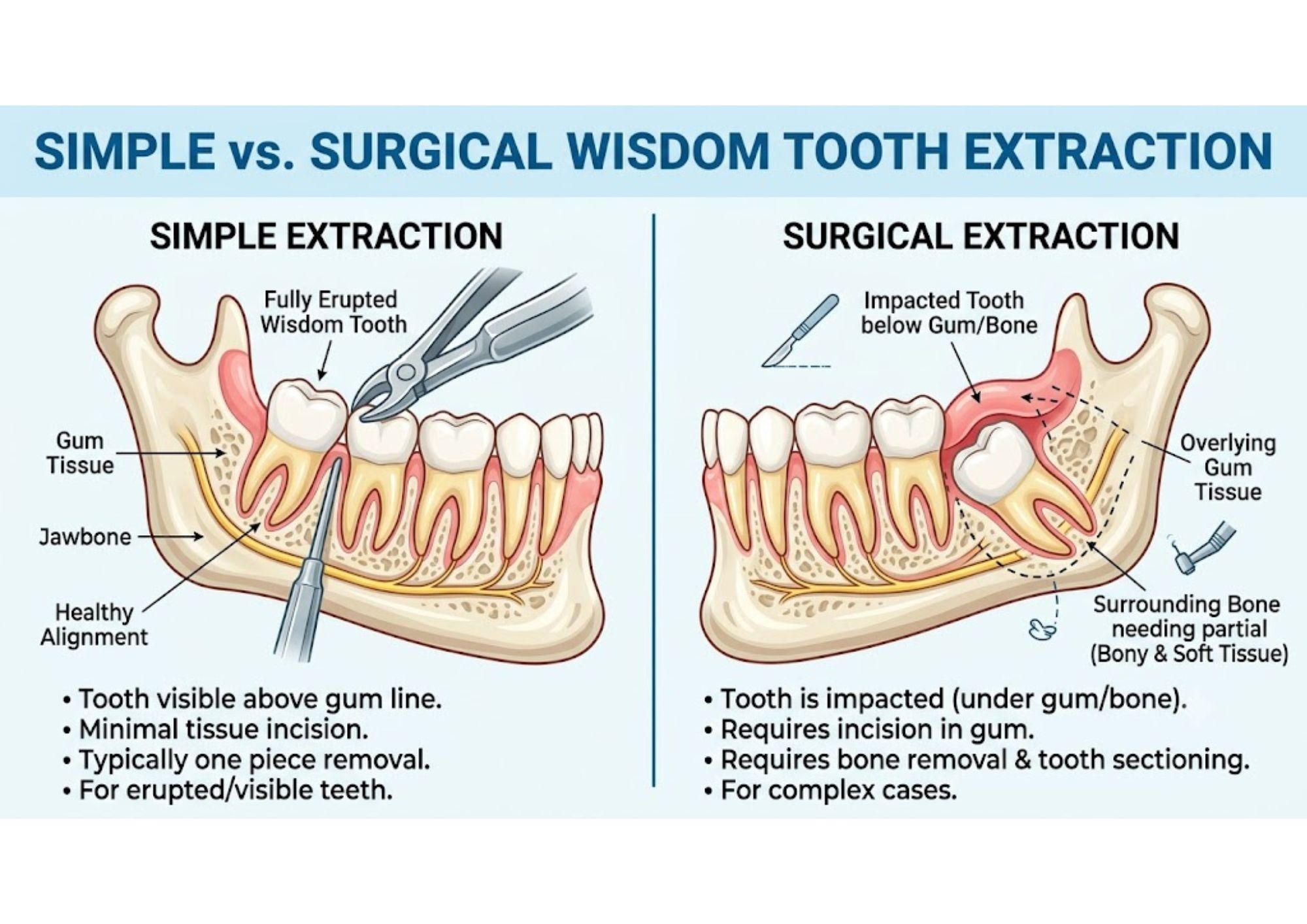
The short answer: it comes down to whether the tooth is sitting where it should be, or hiding under gum and bone.
Feature | Simple Extraction | Surgical Extraction |
Tooth Position | Fully erupted and clearly visible above the gumline | Partially erupted or fully impacted beneath the gums or bone |
Bone or Gum Cutting | Not required | Often required to access the tooth |
Anesthesia | Local anesthesia | Local anesthesia, occasionally combined with sedation depending on complexity |
Root Shape | Usually single and relatively straight roots | Often multiple, curved, or difficult-to-access roots |
Post-Treatment Discomfort | Minimal discomfort and quicker recovery | Moderate discomfort with a longer recovery period |
Both cases fall under what most people simply call "getting a tooth pulled," but the experience, and the pricing, look quite different depending on which category applies. Plenty of patients also worry that any extraction means real pain either way. The reality, covered in more detail in painless tooth extraction, myths versus facts, is that modern anesthesia has made even surgical cases far more comfortable than most people expect.
Wisdom Tooth Extraction Cost in Mumbai
1. Simple extraction cost
For a fully erupted, upright tooth that comes out cleanly with basic instruments, cost stays on the lower end of the scale. This is the most straightforward category, minimal chair time, minimal aftercare, and the quickest bounce-back.
2. Surgical extraction cost
Once a tooth is broken at the gumline or sitting at an awkward angle, a small incision becomes necessary to access it properly. This naturally pushes cost higher than a simple extraction, reflecting the additional time, precision, and skill involved.
3. Impacted wisdom tooth cost
The most complex tier. A tooth trapped fully or partially under bone or gum tissue often needs bone removal and stitches to extract safely. This sits at the higher end of the pricing scale and typically requires more experienced hands.
4. Extraction under sedation
For patients who feel genuinely anxious about the procedure, sedation is an option worth discussing. It costs more due to the additional monitoring and expertise involved, but for someone who would otherwise avoid treatment out of fear, it's often worth every rupee.
A personalized quote after an X-ray gives the most accurate picture, since two "simple-looking" extractions can turn out quite different once the tooth's actual position is visible on imaging.
What Else Adds to the Bill
A quoted procedure cost rarely tells the whole story. A complete, transparent estimate should also factor in:
- Diagnostics. An X-ray or, for more complex cases, a 3D CBCT scan to map out root position and proximity to nerves.
- Medication. Painkillers and antibiotics for the days following the procedure.
- Follow-up visit. A check-in to confirm healing is on track.
Asking upfront what's included in a quote, and what might show up as a separate line item later, saves confusion down the line.
What Happens If a Painful Wisdom Tooth Is Ignored
Postponing treatment rarely makes the problem disappear on its own. What it usually does is buy time for the situation to get worse.
- Infection spreads to surrounding tissue and, in some cases, the jawbone
- Pain intensifies and becomes harder to manage with over-the-counter medication
- A cyst can form around an impacted tooth left untreated long enough
- Neighboring teeth risk damage from trapped food and spreading infection
- A once-simple case can shift into surgical territory, with the corresponding jump in cost
Good daily habits go a long way toward avoiding this in the first place. The guide on cleaning wisdom teeth properly has practical tips for keeping the area free of trapped food and plaque while a decision on removal is still being made.
What to Expect During Recovery
Recovery follows a fairly predictable pattern, and knowing the timeline ahead of time makes the whole process far less nerve-wracking.
- First 24 hours: Mild bleeding, some numbness, and general discomfort are normal.
- Day 2 to 3: Swelling tends to peak around here before it starts easing off.
- Day 4 to 7: Pain drops noticeably, and eating normally becomes much easier.
- Week 2: Gum tissue continues healing, and most daily activities feel completely normal again.
- 4 to 6 weeks: Full healing of the extraction site in most cases.
For a closer look at what the day of the procedure itself actually feels like, from numbing to aftercare instructions, the guide on what to expect during a painless tooth extraction walks through it step by step.
Dealing with a wisdom tooth that's been more bark than bite for weeks now? A quick evaluation and X-ray settle exactly what's needed and what it'll cost, no guessing required.
Extraction vs Root Canal, When Is Removal Actually the Right Call
This comparison comes up constantly, and the honest answer depends on the specific tooth. Extraction costs less upfront, but a missing tooth may eventually need a dental implant or bridge to fill the gap. Root canal treatment costs more at the outset but preserves the natural tooth entirely. For wisdom teeth specifically, extraction is almost always the recommended path, since these molars rarely serve much functional purpose and are harder to keep clean regardless. For other teeth further forward in the mouth, saving the natural tooth through root canal treatment is usually worth strong consideration first.
After Extraction, Should the Gap Be Filled?
For a wisdom tooth, the answer is usually no. These sit at the very back of the mouth and rarely affect the bite or the smile once removed. For any other tooth extracted for reasons other than wisdom teeth, though, an empty gap doesn't just sit there quietly. Neighboring teeth can tilt into the space over time, the bite can shift, and bone loss can begin at the site. Patients facing this situation benefit from exploring how modern implant options have made long-term tooth replacement more predictable than it used to be.
Questions Worth Asking Before Booking
Walking into a consultation with a short mental checklist makes the whole process smoother:
- Is this a simple or surgical extraction?
- Will an X-ray be taken before deciding on the approach?
- What type of anesthesia will be used?
- What does recovery actually involve, and what should be avoided in the days after?
- Is any tooth replacement needed once healing is complete?
A good dentist answers all of this clearly before touching a single instrument.
The Bottom Line on Wisdom Tooth Extraction
Not every wisdom tooth needs to come out, but a painful, swollen, or infected one rarely improves by simply waiting it out. Acting early almost always means a simpler procedure, a shorter recovery, and a smaller bill than waiting for things to escalate. If that dull ache at the back of the jaw has been part of the background for a few weeks now, an evaluation is worth booking before it turns into something more urgent.
A quick X-ray and consultation at the Radiant Smiles Dental Clinic, Chembur gives a clear, honest answer on what's needed and what it'll cost.
Frequently Asked Questions
1. How much does wisdom tooth extraction cost in Mumbai?
Cost depends on whether the extraction is simple or surgical. Fully erupted teeth removed with basic instruments cost considerably less than impacted teeth requiring bone or gum removal. A personalized quote after an X-ray gives the most accurate figure.
2. Is wisdom tooth removal painful?
The procedure itself is done under local anesthesia and is generally not painful during the extraction. Mild discomfort and swelling for a few days afterward is normal and manageable with prescribed medication.
3. How long is recovery after wisdom tooth extraction?
Simple extractions typically settle within a few days. Surgical or impacted extractions take longer, usually one to two weeks for the bulk of the discomfort to resolve, with complete healing of the site taking around four to six weeks.
4. Do all four wisdom teeth need to be removed together?
Not necessarily, though many patients choose to remove all four in one sitting to avoid multiple separate recovery periods. The right approach depends on each tooth's position and whether all four are actually causing problems.
5. What happens if an infected wisdom tooth is left untreated?
The infection can spread to surrounding tissue and, in more serious cases, the jawbone. Pain typically worsens over time, and what may have started as a simple extraction can turn into a more complex surgical case.
Dr. Vishwas Madan
MDS (Periodontics & Oral Implantology) — Periodontist & Implantologist
Dr. Vishwas Madan is a highly esteemed Periodontist and Implantologist, holding a Master's in Dental Surgery (MDS) in Periodontics and Oral Implantology. His training includes mentorship under world-renowned Dr. Ziv Simon in Beverly Hills, California, where he mastered cutting-edge implant techniques. With over a decade of experience, Dr. Madan specialises in advanced dental implants and full-mouth rehabilitation, having successfully treated over 15,000 patients using digital smile design and guided implantology.
His accolades include the Pierre Fauchard Academy Award nomination, Famdent Indian Dental Oscars, the XL Award for Practice Management, and the Leadership Award of the Year (2024). A double gold medallist and recipient of the IDA-Colgate & TATA Scholarships, Dr. Madan brings complex surgical expertise to Radiant Smiles, treating periodontally compromised patients with the highest level of care.
Book an Appointment with Dr. Vishwas Madan