


Do You Really Need Your Wisdom Teeth Removed? Signs, Risks and When to See a Dentist

Wondering if you really need your wisdom teeth removed? It’s not always a yes but it’s never a guess. Many people assume no pain means no problem but wisdom teeth can quietly cause damage beneath the surface. From infections and crowding to hidden cysts, the risks often build without obvious symptoms. That is why a proper dental check up and X ray matters more than how you feel. If your wisdom teeth are healthy, aligned and easy to clean, they can stay. But if not, early removal can save you bigger issues later. One quick evaluation can give you clarity and peace of mind.
There is a conversation that happens in dental clinics across India almost every single day. A patient in their early twenties sits down, hears that their wisdom teeth may need to come out, and immediately says, "But they are not even hurting. Why would I remove them?"
It is a completely fair question. And the honest answer is: sometimes you do not need to. But sometimes, waiting is exactly what causes the problem.
Here is what actually helps make that decision, and why an X-ray and a proper check-up matter far more than pain levels alone.
Get a closer look at the technique, watch the full demonstration
Why Wisdom Teeth Are Different From Every Other Tooth?
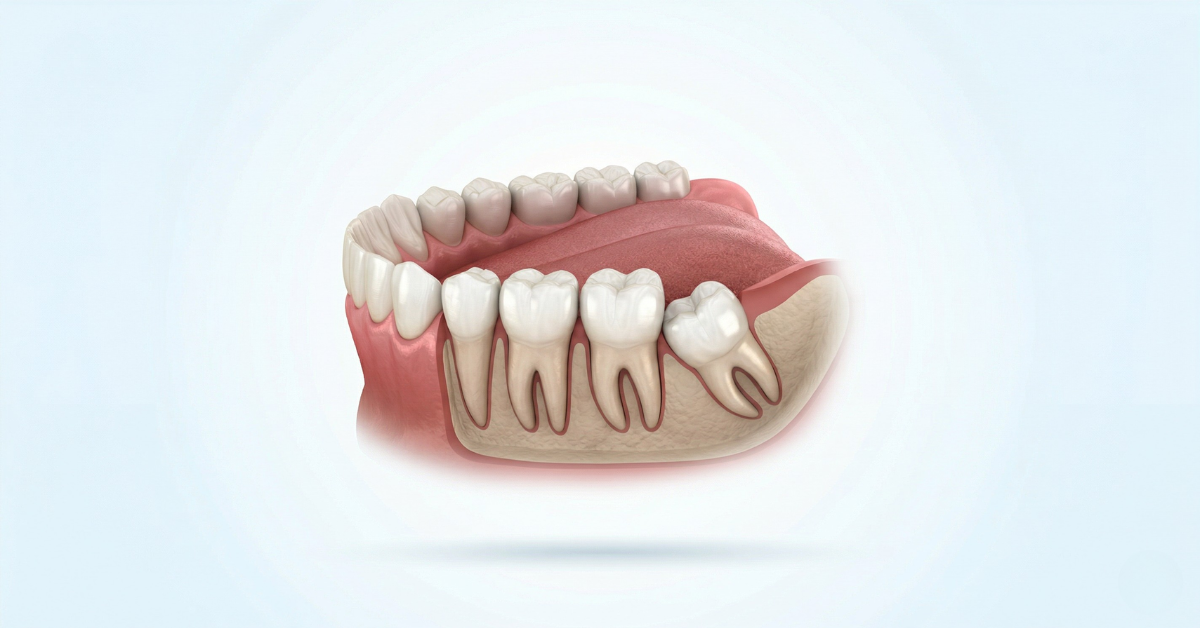
Wisdom teeth get their name for a reason. Unlike every other tooth that comes in during childhood, these third molars erupt much later, typically somewhere between 18 and 24 years of age. By then, it is assumed life has made you a little wiser. Hence the name.
But here is the biological reality that makes wisdom teeth uniquely complicated: by the time they try to come in, the jaw has already finished developing. And over generations of human evolution, jaw sizes have gradually become smaller. The space that earlier humans had for these teeth simply does not exist in most mouths today.
So wisdom teeth arrive late, often uninvited, into a jaw that has no room left for them.
The result? They do not always grow straight. They can come in at an angle, tilt sideways, grow partially through the gum, or never surface at all, staying trapped inside the jaw entirely. In some cases, they erupt normally and cause no trouble whatsoever. But that is the exception, not the rule.
There is one more problem that often goes unmentioned. Because of where wisdom teeth sit, right at the back of the mouth, they are genuinely difficult to clean. Most people cannot reach them properly with a toothbrush, let alone floss between them. That persistent inaccessibility makes them far more prone to decay. And the gum tissue surrounding them, especially when the tooth has only partially emerged, tends to stay inflamed.
Signs your wisdom teeth may need to come out
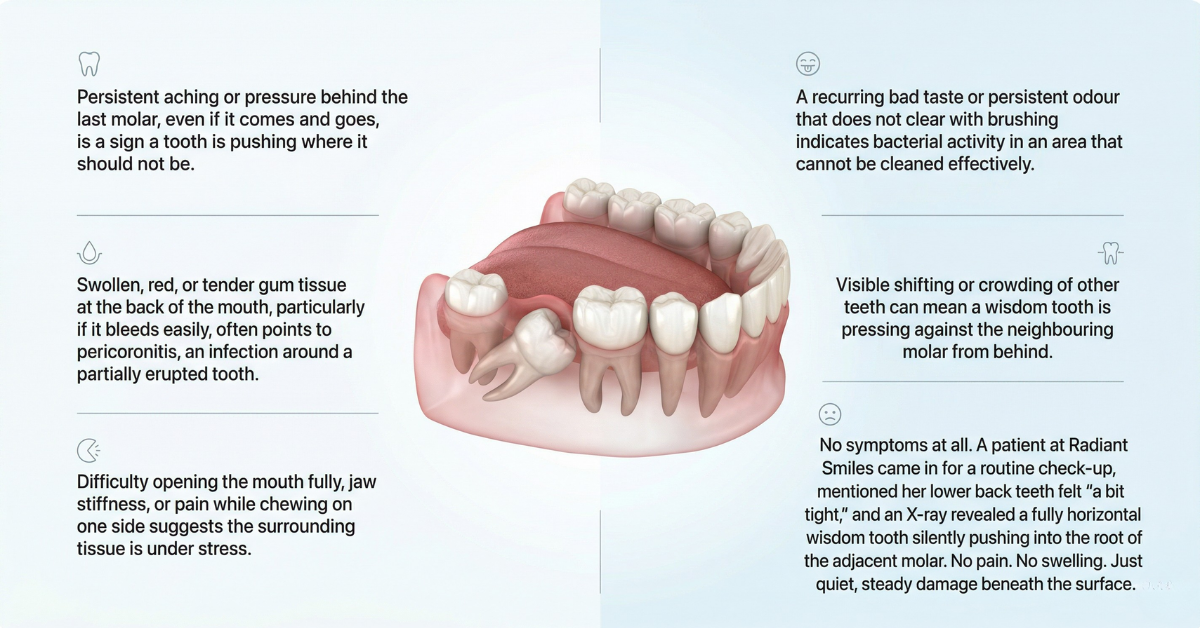
- Persistent aching or pressure behind the last molar, even if it comes and goes, is a sign a tooth is pushing where it should not be.
- Swollen, red, or tender gum tissue at the back of the mouth, particularly if it bleeds easily, often points to pericoronitis, an infection around a partially erupted tooth.
- Difficulty opening the mouth fully, jaw stiffness, or pain while chewing on one side suggests the surrounding tissue is under stress.
- A recurring bad taste or persistent odour that does not clear with brushing indicates bacterial activity in an area that cannot be cleaned effectively.
- Visible shifting or crowding of other teeth can mean a wisdom tooth is pressing against the neighbouring molar from behind.
- No symptoms at all. A patient at Radiant Smiles came in for a routine check-up, mentioned her lower back teeth felt "a bit tight," and an X-ray revealed a fully horizontal wisdom tooth silently pushing into the root of the adjacent molar. No pain. No swelling. Just quiet, steady damage beneath the surface.
That last point is why an X-ray is not optional when evaluating wisdom teeth. What cannot be felt can still cause significant harm.
What If They Are Not Causing Any Pain at All?
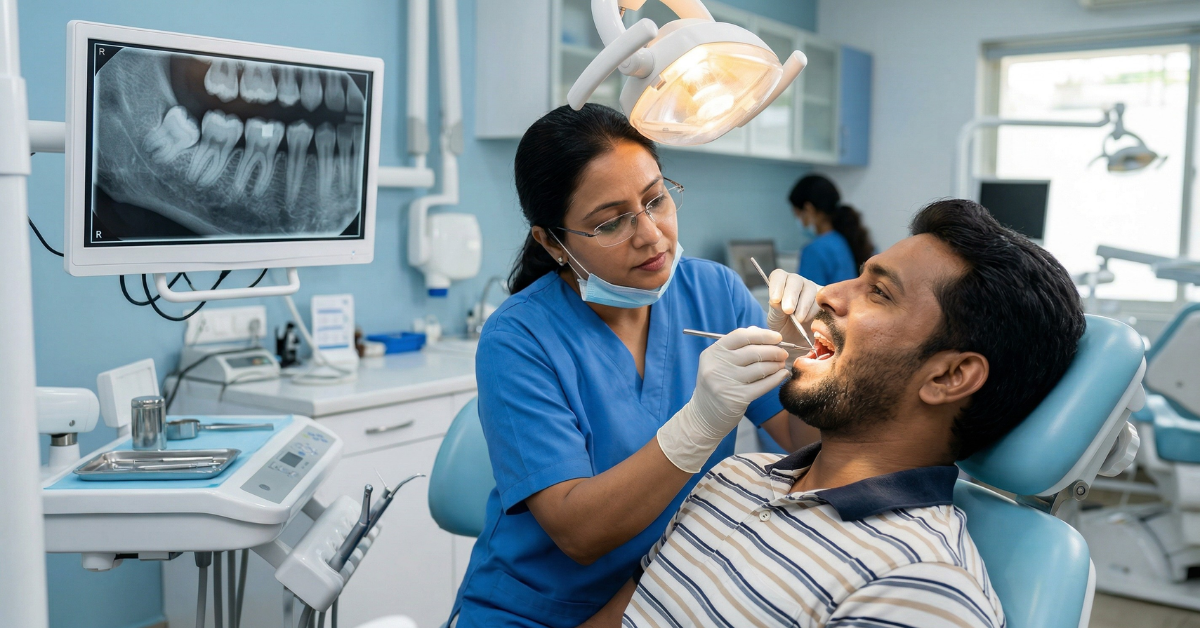
This is the part of the conversation most people find counterintuitive. No pain feels like no problem. But impacted wisdom teeth can cause significant damage, to neighbouring teeth, to the jaw bone, to surrounding nerves, without producing a single twinge of discomfort until the situation becomes serious.
A fully impacted wisdom tooth trapped in the jaw can trigger cyst formation over time. If those cysts are left untreated, they can hollow out the jaw bone and damage the roots of nearby teeth. That is not a minor inconvenience, it is a structural problem that becomes significantly harder to treat the longer it goes unaddressed.
There is also the sinus connection that surprises most patients. Upper wisdom teeth sit in close proximity to the sinus cavities. When they become infected or impacted, the result can be unexplained sinus pressure, congestion, or facial pain that no ENT visit seems to resolve.
Wisdom teeth can stay if, and only if, all four of these conditions are true: they are fully erupted, completely healthy, correctly positioned with a proper biting alignment, and accessible enough to clean properly every day. If even one of those conditions is not met, removal is almost always the better long-term decision.
Why the Age Window Matters More Than Most People Realise?
Factor | Age 15 to 22 | Age 23 to 29 | Age 30 plus | Risk Level |
Root development | Incomplete easier extraction | Mostly complete | Fully formed more complex | Low at 15 to 22 |
Bone density | Less dense less resistance | Moderately dense | Hardened more involved procedure | Higher at 30 plus |
Procedure duration | Shorter approximately 45 min | Moderate | Longer more involved | Low at 15 to 22 |
Healing speed | Faster body recovers quickly | Moderate | Slower recovery | Low at 15 to 22 |
Complication risk | Lower nerve involvement rare | Moderate | Higher dry socket numbness swelling | Higher at 30 plus |
Ideal timing India | College break semester holiday summer vacation | Plan around work schedule | Requires more recovery planning | Low at 15 to 22 |
What the Procedure and Recovery Actually Look Like
Wisdom tooth extraction sounds daunting. In reality, for most straightforward cases, it is a well-established procedure done under local anaesthesia. There is no pain during the extraction itself, pressure and movement, yes, but not pain.
Recovery for a simple extraction typically runs three to five days. For surgical removal of an impacted tooth, it may stretch to a week. The first 48 hours are the most uncomfortable, managed well with cold packs applied to the cheek, prescribed or over-the-counter ibuprofen, and rest.
For the diet during recovery, soft and easy-to-eat foods work best. Khichdi, curd rice, dal, mashed potato, and thick smoothies are all excellent choices. Anything requiring hard biting or chewing, roti, chips, raw vegetables, should wait until the area has healed.
A few warning signs after surgery that warrant a call to the dentist: pain that worsens significantly after day three rather than improving, a dry or empty-feeling socket where the tooth was removed (dry socket), fever, or swelling that spreads rather than subsides.
No Pain Does Not Always Mean No Problem
Not every wisdom tooth needs to come out. That is the truth. But every wisdom tooth deserves to be properly looked at, with an X-ray, not just a visual check.
Human jaw anatomy has changed faster than wisdom teeth have adapted. These teeth arrive into a modern mouth that often simply does not have room for them, and the consequences of ignoring that mismatch tend to show up quietly, in decay, in bone loss, in a neighbouring molar that starts to shift, long before any pain arrives.
The decision is not complicated when the right information is on the table. One X-ray, one honest conversation with a dentist who can show exactly what is happening inside the jaw, and the path forward becomes clear.
Not sure whether your wisdom teeth need to come out? Book a wisdom tooth assessment at Radiant Smiles Dental Clinic, one X-ray, one conversation, and a clear answer.
Frequently Asked Questions
1. Do wisdom teeth always need to be removed?
No. If they are fully erupted, correctly positioned, cavity-free, and easy to clean, they can stay. But most wisdom teeth do not meet all four conditions. A clinical examination and X-ray are the only reliable way to know, not waiting for pain to develop.
2. What are the signs that wisdom teeth need to be removed?
Persistent pain or pressure behind the last molar, swollen or bleeding gum tissue at the back of the mouth, recurring bad taste or odour, difficulty opening the jaw fully, and shifting or crowding of other teeth. Some cases show no symptoms at all, which is exactly why routine X-rays matter.
3. Is wisdom tooth extraction painful?
The procedure is done under local anaesthesia, so there is no pain during the extraction. Post-operative soreness for the first two to three days is normal and manageable with cold packs, ibuprofen, and soft foods. Most people return to their regular routine within three to five days.
4. What happens if wisdom tooth pain is ignored?
It rarely stays as just pain. An untreated wisdom tooth usually has an underlying infection, impaction, or pressure on a neighbouring tooth that quietly worsens over time. Left long enough, this can lead to cysts, jaw bone damage, or root damage to the adjacent molar, all of which make eventual treatment significantly more complex.
5. What is the best age to get wisdom teeth removed?
Between 15 and 22 years is the ideal window. Roots are not fully formed, the jaw bone is softer, and recovery is faster than it would be even five years later. Many families in India time this during college holidays, and from a dental standpoint, that timing is genuinely well chosen.
Dr. Ameya Pai
Oral & Maxillofacial Surgeon — Head & Neck Oncoplastic Surgeon
Dr. Ameya is a distinguished Consultant Head and Neck OncoPlastic Surgeon with specialised training from the prestigious Tata Memorial Hospital, Mumbai. After his graduation training in Ahmednagar and post-graduation in Oral and Maxillofacial Surgery in Navi Mumbai, he brings over 10 years of experience treating a wide range of oral and maxillofacial malignancies and pathologies.
He is highly skilled in salivary gland pathologies, reconstructive and rehabilitative surgeries, third molar surgeries, cyst and tumor excisions, dental implants, and maxillofacial trauma, having been involved in treating over 1,000 head and neck cancer patients. An avid researcher with multiple national and international publications, Dr. Ameya is also the founder of Oncomed Life, embodying his philosophy of "Improving life — Together." At Radiant Smiles, he consults on major and minor surgical extractions, lesion excisions, biopsies, and facial reconstruction surgeries.
Book an Appointment with Dr. Ameya Pai