


How to Clean Wisdom Teeth Properly: Dentist Tips to Prevent Infection and Decay (2026 Guide)

Cleaning wisdom teeth properly is harder than it looks, and even people who brush twice daily often miss them. Because they sit so far back, plaque and food easily build up, increasing the risk of decay and infection. With the right technique, like angling your brush correctly and relaxing your cheeks, along with tools such as an end tuft brush or water flosser, you can keep them healthy. If a tooth is partially erupted, extra care is essential to prevent infection. Regular dental check ups and X rays help catch hidden issues early, because what you cannot see can still cause damage.
Here is something that surprises a lot of patients. They come in for a routine check-up at Radiant Smiles, brush twice a day without fail, and still end up with a cavity sitting quietly on their wisdom tooth. No impaction. No crowding. Just a tooth that was never being cleaned quite right.
It happens more often than most people realise. And the reason is almost always the same, position. Wisdom teeth sit so far back in the mouth that standard brushing habits, however sincere, rarely reach them properly. The good news is that once the technique is right and the right tools are in place, keeping them clean is genuinely manageable.
This guide covers exactly that.
See exactly how this is done, step by step 👉
Why Wisdom Teeth Are So Hard to Keep Clean?
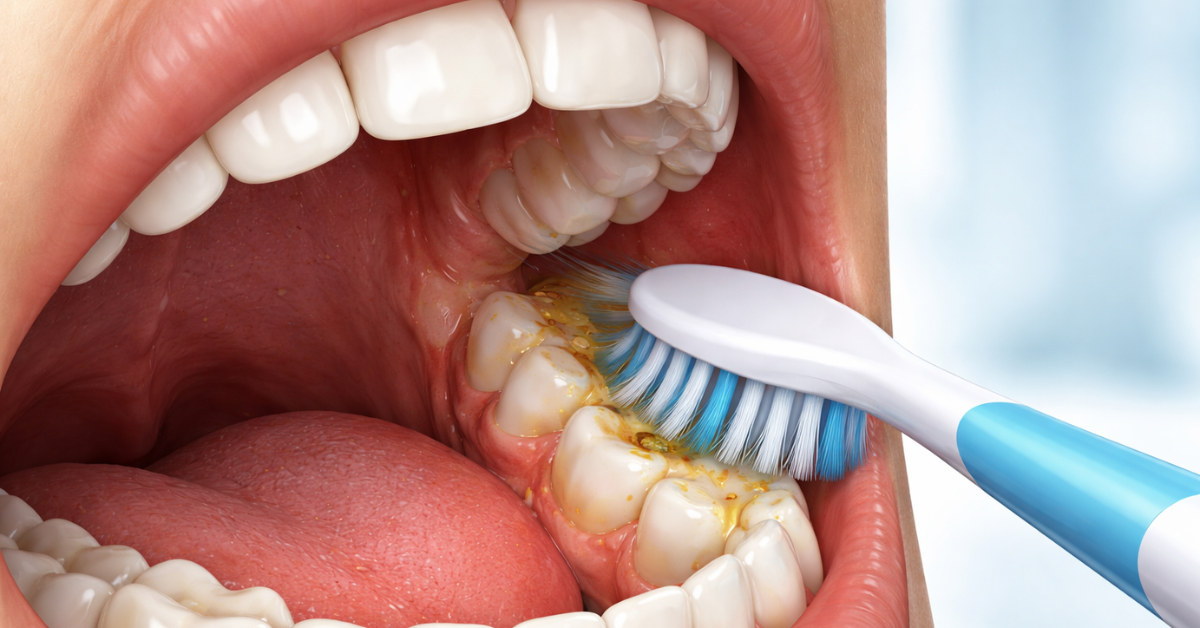
Every other tooth in the mouth has the advantage of being somewhere accessible. Wisdom teeth do not. They sit at the very back of the jaw, often partially obscured by cheek tissue, gum folds, and the curve of the arch itself. A toothbrush pointed straight at the mouth simply cannot make it all the way behind the last molar without a deliberate effort to reposition it.
The anatomy creates a natural blind spot. Food and plaque settle into the gaps around these teeth, along the gumline, and especially in the narrow space between the second and third molar. Most people rush through brushing at the back, a few quick strokes and done, without realising how little of the tooth surface they are actually reaching.
The problem becomes more serious when a wisdom tooth has only partially erupted through the gum. A flap of gum tissue, known as the operculum, covers part of the tooth and creates a hidden pocket underneath. Food debris collects there, bacteria multiply, and the result is pericoronitis, an infection of the surrounding gum tissue that causes swelling, pain, and sometimes difficulty opening the mouth. It does not take long to develop, and it does not resolve on its own.
How to brush wisdom teeth the right way
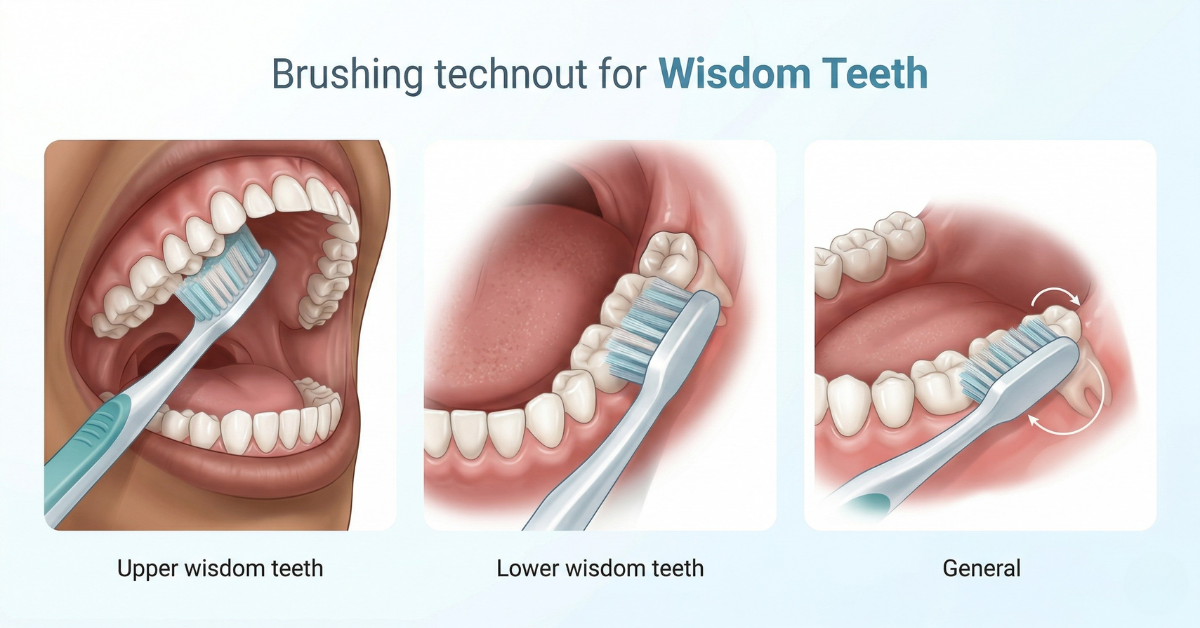
Upper wisdom teeth
- The cheeks are the main obstacle, they prevent the brush from angling far enough back to reach behind the tooth.
- Close the mouth slightly while brushing the upper back area. This relaxes the cheeks instead of pulling them taut, giving the brush proper access to the gumline and back surface.
Lower wisdom teeth
- Angle the brush at roughly 45 degrees to the gumline and use gentle circular motions rather than back-and-forth scrubbing. Scrubbing moves plaque around, circular motions lift it away from the gumline.
- If the lower wisdom tooth is partially covered by gum tissue, work the brush carefully along the edge of that flap without pressing hard enough to damage the tissue.
General
- Travel all the way to the back with every brush. Most people spend as little time on wisdom teeth as they do on front teeth. These teeth need more attention, not less, because access is harder and the risk of decay and infection is significantly higher.
The right tools make the difference
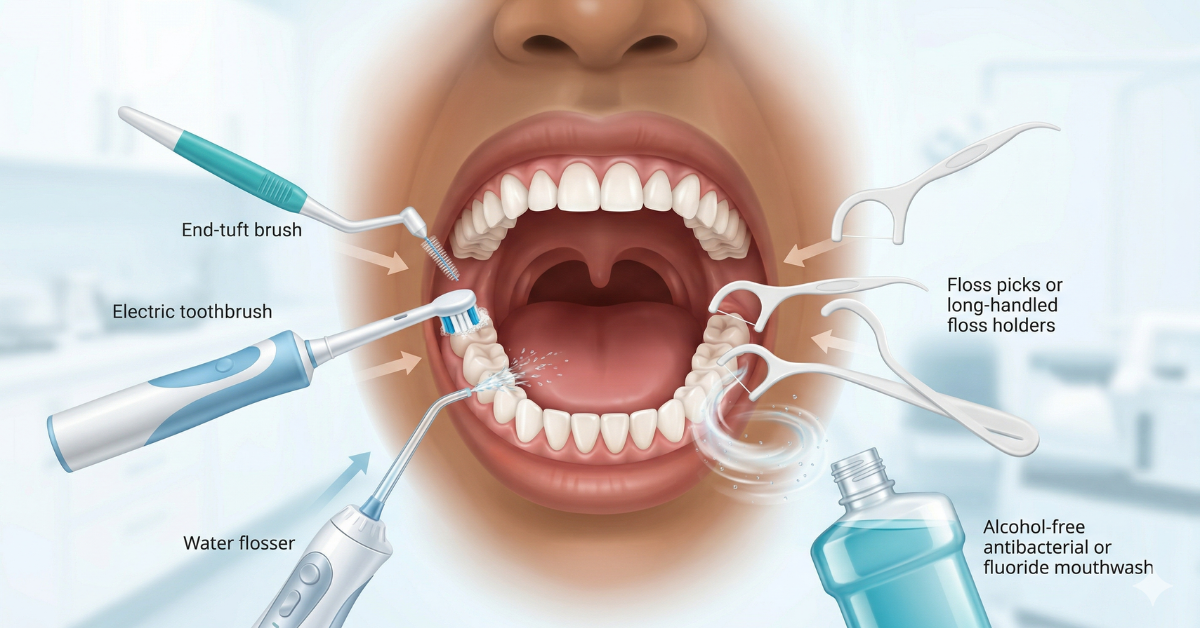
- End-tuft brush. A small, concentrated cluster of bristles designed to reach behind the last molar and clean tight gumline spaces that a full-sized brush head cannot navigate. One of the most useful tools for anyone keeping their wisdom teeth long term, and widely available online across India.
- Electric toothbrush. A small, round, oscillating head performs significantly better in posterior areas than a manual brush. The oscillating motion handles what most people forget to do manually, and the compact head manoeuvres into corners a standard brush cannot reach.
- Water flosser. Especially valuable when a wisdom tooth is partially erupted. The pressurised water stream flushes debris from under the gum flap and between teeth in a way no brush can replicate. Readily available across Indian cities and major e-commerce platforms, and worth the investment for anyone with back molar concerns.
- Floss picks or long-handled floss holders. Make reaching the space between the second and third molar significantly easier than manoeuvring regular floss that far back with fingers alone.
- Alcohol-free antibacterial or fluoride mouthwash. Used after brushing and flossing, it clears what the tools loosen, kills remaining bacteria, and reduces plaque. It is the last step in the routine, not a substitute for the steps before it.
How to prevent infection when a wisdom tooth is partially erupted?
Daily routine
- The gum flap around a partially erupted tooth will not resolve on its own. It needs a consistent, specific cleaning routine to prevent bacteria from settling in.
- At the first sign of soreness or minor puffiness behind the last molar, begin warm saltwater rinses immediately. Half a teaspoon of salt dissolved in a glass of warm water, rinsed gently around the back of the mouth for 30 seconds, soothes inflamed tissue and slows bacterial activity. The clinical value behind this familiar household remedy is well established.
- Use a water flosser at a low pressure setting to flush debris from under the gum flap. A small curved-tip syringe used for ear or wound irrigation works just as well. The goal is to flush gently, not force water deeper.
When home care is no longer enough
- Swelling that worsens rather than settles after a day or two.
- Pain that spreads to the jaw or ear.
- Difficulty opening the mouth fully.
- A persistent bad taste that does not clear despite rinsing.
Any one of these is a signal to visit the dentist without further delay. At this point, home care has reached its limit.
Diet Habits That Protect Wisdom Teeth From Decay
Even with excellent brushing technique and the right tools, diet can quietly work against every effort made at the sink. The bacteria responsible for tooth decay feed on sugar and produce acid as a byproduct. That acid attacks the enamel for roughly 20 minutes after every sugary exposure. When snacking happens frequently throughout the day, biscuits between meals, a sweet chai in the afternoon, mithai after dinner, gutka or tobacco products at any point, the back molars are under near-constant acid attack with very little recovery time in between.
The wisdom teeth are particularly vulnerable because even a small cavity in an awkward position may not be reachable for a filling. Prevention is genuinely the only good option here.
Using fluoride toothpaste specifically is important for wisdom teeth. Fluoride strengthens enamel and helps remineralise areas of early decay before they become cavities. It is one of the most evidence-backed tools in dentistry, and it works most effectively at the back of the mouth where saliva flow and natural protection are lower.
When Cleaning Is No Longer Enough
This is the part of the conversation that matters most, and it deserves honesty. Sometimes, despite genuine effort, a wisdom tooth reaches a point where cleaning alone cannot protect it or the teeth around it.
If decay becomes too deep, the position of the tooth makes filling it either impossible or pointless, the filling will not hold in a location where cleaning cannot be maintained. In these situations, extraction becomes the most sensible path forward. Whether that means a straightforward non-surgical removal or a more involved surgical procedure depends entirely on how the tooth sits, how deep the roots go, and what the surrounding bone looks like. A dentist assessment and X-ray will determine the right approach for each individual case.
The most important thing to understand here is that early intervention always produces better outcomes. A patient at Radiant Smiles once came in with pain in the adjacent molar, it turned out the real problem was a partially erupted wisdom tooth that had been quietly damaging the neighbouring root for over a year. If the wisdom tooth had been properly monitored, the neighbouring tooth could have been saved entirely.
Waiting is rarely the safer option.
The Role of Regular Check-Ups in Keeping Wisdom Teeth Healthy
Home care, however thorough, cannot replace what professional cleaning achieves. Early cavities on wisdom teeth are genuinely easy to miss. They form in angles, under gum tissue edges, and along surfaces that are never directly visible in a bathroom mirror.
Every six months, a professional clean removes the plaque and tartar that has accumulated in areas the brush and floss did not quite reach. An X-ray taken at that visit can show what no visual examination can, decay developing between teeth, bone changes around the wisdom tooth root, or shifting of adjacent teeth that has not yet become noticeable. Catching these things early is what keeps small problems from becoming large ones.
The Back of the Mouth Deserves as Much Attention as the Front
Wisdom teeth are not automatically a problem. Plenty of people keep them for life without any significant issues. But they do demand a higher level of care, better tools, and more deliberate technique than any other tooth in the mouth.
The cheek-relaxing technique for upper wisdom teeth, the 45-degree circular motion for lower ones, the end-tuft brush behind the last molar, the saltwater rinse at the first hint of inflammation, none of these are complicated. They just need to become a habit. And for those cases where cleaning alone is not sufficient, knowing when to act and acting early is what protects everything else.
Not sure if your wisdom teeth are being cleaned properly? Book a check-up at Radiant Smiles Dental Clinic, one appointment can catch what a mirror never will.
Frequently Asked Questions
1. How do you clean wisdom teeth that are hard to reach?
For upper wisdom teeth, close the mouth slightly while brushing so the cheeks relax and the brush reaches behind the tooth. For lower wisdom teeth, angle the brush all the way to the back at 45 degrees. An end-tuft brush and a water flosser significantly improve access where a regular brush cannot reach on its own.
2. How do I know if my wisdom tooth is infected?
Early signs include swelling or redness behind the last molar, a persistent bad taste, difficulty opening the jaw fully, and discomfort when chewing. Even mild inflammation is a signal to start warm saltwater rinses immediately and book a dental appointment rather than waiting it out.
3. Can wisdom teeth get cavities even if they are not impacted?
Yes, and it happens more often than expected. Fully erupted wisdom teeth are still highly prone to decay because most people do not brush far enough back to clean them properly. A fluoride toothpaste, an end-tuft brush, and daily flossing reduce this risk significantly.
4. What is the best way to clean partially erupted wisdom teeth?
A water flosser or curved-tip syringe can gently flush debris from under the gum flap that forms around a partially erupted tooth. Warm saltwater rinses should begin at the very first sign of inflammation to prevent pericoronitis from developing.
5. How often should wisdom teeth be professionally cleaned?
Every six months. Professional cleaning removes tartar from areas home brushing cannot fully reach, and the accompanying check-up allows a dentist to monitor for early decay or bone changes that would not be visible during self-examination.
Dr. Ameya Pai
Oral & Maxillofacial Surgeon — Head & Neck Oncoplastic Surgeon
Dr. Ameya is a distinguished Consultant Head and Neck OncoPlastic Surgeon with specialised training from the prestigious Tata Memorial Hospital, Mumbai. After his graduation training in Ahmednagar and post-graduation in Oral and Maxillofacial Surgery in Navi Mumbai, he brings over 10 years of experience treating a wide range of oral and maxillofacial malignancies and pathologies.
He is highly skilled in salivary gland pathologies, reconstructive and rehabilitative surgeries, third molar surgeries, cyst and tumor excisions, dental implants, and maxillofacial trauma, having been involved in treating over 1,000 head and neck cancer patients. An avid researcher with multiple national and international publications, Dr. Ameya is also the founder of Oncomed Life, embodying his philosophy of "Improving life — Together." At Radiant Smiles, he consults on major and minor surgical extractions, lesion excisions, biopsies, and facial reconstruction surgeries.
Book an Appointment with Dr. Ameya Pai