


Bad Breath (Halitosis): Real Causes & How to Fix It

Key takeaways
- Roughly 1 in 4 people has measurable halitosis at any given time, it's far more common than most people realise.
- In more than 85% of cases, the cause is entirely within the mouth and a dentist can identify and treat it directly.
- The most overlooked cause is bacteria coating the back of the tongue, an area most people barely brush.
- If odour returns within an hour of brushing or comes with bleeding gums, the cause is likely dental, gum disease, decay, or a leaking filling.
- If odour persists despite good oral hygiene, or has a fruity, ammonia-like, or fishy character, the source may be non-dental and needs a GP or specialist.
- A dedicated tongue scraper, used correctly, makes a measurably bigger difference than mouthwash alone.

Bad breath is one of those things people rarely bring up with a dentist. It feels too embarrassing, too personal, somehow less medical than a toothache or a cavity. But halitosis, the clinical term for persistent bad breath, is one of the most common oral health complaints there is. Two independent population studies, one involving 1,500 people and another involving 2,000, both found that roughly 25 percent of the population has measurable halitosis at any given time. That's one in four people walking into a room and worrying about it.
The good news is that in more than 85 percent of cases, the cause is entirely within the mouth, which means a dentist can identify it and treat it directly. This isn't a condition that requires indefinite mouthwash management. It has a source, and fixing the source fixes the problem.
This guide covers why bad breath actually happens, what a genuinely effective daily routine looks like, and what professional bad breath treatment involves for patients in Chembur and surrounding areas like Ghatkopar, Govandi, Wadala, Sion, and Kurla.
Why Bad Breath Happens: The Real Causes
The primary driver of halitosis is bacteria in the mouth breaking down food debris and releasing volatile sulfur compounds, the foul-smelling gases responsible for the odour. The location and volume of those bacteria, and what's helping them thrive, determines which cause is at play and which treatment will actually work.
1. Tongue Coating: The Most Overlooked Cause
The back of the tongue has a complex, cratered surface covered in tiny projections called papillae. That structure traps significantly more bacteria than any other part of the mouth, and peer-reviewed research identifies anaerobic bacteria concentrated in this posterior region as the primary source of volatile sulfur compounds in most halitosis cases. Most people brush the tip of their tongue briefly or skip it entirely and miss the back completely, which is where the problem is actually sitting.
2. Gum Disease and Periodontal Pockets
As gums pull away from teeth due to gingivitis or periodontitis, deep pockets form between the gum tissue and the tooth root. These pockets fill with odour-causing bacteria and are completely unreachable by brushing or flossing at home. The result is a persistent, distinct odour that no mouthwash covers for more than a few minutes. Patients who also notice bleeding when they brush or gums that look like they're receding will find the full picture in the gum disease treatment guide.
3. Dry Mouth (Xerostomia)
Saliva physically washes the mouth and neutralises bacterial acids between meals. When saliva flow drops, bacteria multiply rapidly on food debris that isn't being cleared. This is more common than most people realise: antihistamines, antidepressants, blood pressure medications, and dozens of other commonly prescribed drugs list dry mouth as a side effect. Mouth breathing at night has the same drying effect. It's one reason halitosis is almost always worse in the morning before eating or drinking anything.
4. Untreated Cavities and Failing Dental Work
Decayed teeth and fillings or crowns that have started to leak create physical spaces where food particles become trapped and bacteria accumulate continuously. These are sources of odour that no oral hygiene routine can reach from the outside. Patients who also notice sensitivity, a visible dark spot, or a rough patch on a tooth alongside breath concerns should read the early cavity signs guide for a clearer picture of what's happening.
5. Diet and Lifestyle Factors
Garlic, onions, and strongly spiced foods release sulphur-containing compounds that absorb into the bloodstream and are exhaled through the lungs, which is why mouthwash doesn't fully resolve food-related breath. The odour has to leave the body through normal metabolism, and that takes time. Alcohol and caffeine both reduce saliva flow and worsen dry mouth. Tobacco directly alters the oral bacterial environment, causes dry mouth, and significantly increases the risk of gum disease, making it a compounding factor rather than just a direct odour source. One evidence-backed point that surprises most people: skipping breakfast is associated with higher halitosis risk, likely because eating stimulates saliva flow that clears the bacterial buildup from overnight.
6. Non-Dental Causes Worth Knowing About
A small but important group of halitosis cases originate outside the mouth entirely. Sinus infections and post-nasal drip produce odorous fluid at the back of the throat. Tonsil stones, calcified food debris that forms in the crypts of the tonsils, produce a distinctly foul smell that has no dental source and no dental fix. GERD allows stomach acid and gases to reflux into the oesophagus and sometimes the mouth. Diabetic ketoacidosis produces a fruity breath odour that's distinctly different from bacterial halitosis. Kidney and liver disease can cause breath odour from toxin accumulation that the organs are failing to filter normally.
These need medical rather than dental management, and the section below on when to see a doctor covers how to tell them apart.
Cause and Treatment Quick Reference
Cause | Characteristic Smell | Who Treats It | Typical Treatment |
Tongue coating | Sulphurous, general malodour | Self-managed or dentist | Tongue scraping and antimicrobial mouth rinse |
Gum disease | Persistent, distinct, unpleasant odour | Dentist or periodontist | Scaling, root planing, and gum treatment |
Dry mouth | Stale breath, often worse in the morning | Dentist or GP | Hydration, saliva substitutes, and medication review |
Cavities or leaking fillings | Localised, sometimes sweet or rotten smell | Dentist | Dental filling or crown replacement |
Tonsil stones | Intensely foul odour originating from the throat | ENT specialist | Removal of tonsil stones |
GERD (Acid Reflux) | Sour or acidic breath | GP or gastroenterologist | Acid reflux management and treatment |
Diabetes or other systemic disease | Fruity or ammonia-like odour | GP or relevant specialist | Diagnosis and management of the underlying condition |
How to Tell If It's More Than Morning Breath
Everyone has some degree of breath odour on waking. Saliva flow slows significantly during sleep and bacteria have hours to accumulate undisturbed. That's normal physiology, not a dental problem. Chronic halitosis is different in pattern, persistence, and how it responds to hygiene.
A Practical Self-Check
The hand-cup-and-sniff method is actually unreliable because the nose adapts quickly to its own environment. A more useful indicator: a persistent bad taste in the mouth, particularly after brushing, is a reasonable proxy for breath others can detect. Licking the back of the wrist, letting it dry for about ten seconds, then smelling it gives a better read on tongue-sourced odour specifically.
Patterns That Point to a Dental Cause
Odour that returns within an hour or two of brushing. Bleeding gums when flossing or brushing. A taste that doesn't clear with rinsing. Sensitivity or a visible dark spot on a tooth alongside breath concerns. Any of these point toward an oral source that a dental assessment can find and address.
Patterns That Suggest Something Non-Dental
Odour that persists despite thorough oral hygiene and a recent dental clearance. Odour accompanied by frequent heartburn, nasal discharge, or throat discomfort. A distinctly fruity, ammonia-like, or fishy smell rather than the typical sulphurous character of bacterial halitosis. These warrant a GP assessment rather than more dental treatment.
A patient came in recently after three months of trying every mouthwash available, convinced a deep cleaning would solve the problem. Assessment found healthy gums and no significant decay. The actual source was a combination of heavy tongue coating at the posterior third of the tongue and a partially erupted lower wisdom tooth with a small flap of gum tissue over it that was trapping food after every meal. Two appointments resolved both issues completely, no ongoing products required.
The Daily Routine That Actually Controls Bad Breath
Knowing how to get rid of bad breath at home starts with addressing all the places bacteria accumulate, not just the tooth surfaces that most people focus on.
Tongue Cleaning: The Step That Makes the Biggest Difference
A dedicated tongue scraper reaches further back than a toothbrush and removes the bacterial biofilm more effectively than bristles do. The technique matters: start as far back as comfortable, apply light pressure, and draw forward in one smooth motion. Rinse the scraper between strokes. A 2019 randomised clinical trial found that patients assigned to the tongue scraper group had significantly lower measured volatile sulfur compound levels than those using mouthwash alone. Once or twice daily, morning being the most impactful, is enough.
Brushing and Flossing Done Properly
Two minutes, twice daily, with a fluoride toothpaste. The areas most people rush through: the back molars, the gumline on all surfaces, and the inner faces of the lower front teeth where tartar builds fastest. Flossing daily removes interdental food debris and plaque that brushing cannot reach and that is a direct and continuous bacterial food source.
The Right Mouthwash, Not Just Any Mouthwash
Mouthwashes that work by masking odour with fragrance are not useful for managing halitosis beyond a few minutes. The ones that make a measurable difference contain active ingredients that target the bacteria producing volatile sulfur compounds: zinc, chlorhexidine, cetylpyridinium chloride, or stannous fluoride all have good evidence behind them. Avoid alcohol-based rinses for daily long-term use as they dry the mouth and can worsen the problem over time. Chlorhexidine is highly effective but is recommended for short courses of up to two weeks rather than indefinite daily use, as prolonged use causes tooth staining.
Hydration and Saliva Support
Plain water drunk regularly throughout the day, rather than only at meals, maintains the washing effect that saliva provides between meals. Sugar-free gum or lozenges stimulate saliva mechanically and are particularly useful in situations where brushing isn't possible, such as after lunch at work.
Cleaning Dental Appliances Daily
Retainers, dentures, mouthguards, and clear aligners harbour the same odour-causing bacteria as teeth and gums if not cleaned properly every day. A quick rinse with water is not sufficient. Each should be cleaned using the method the treating dentist has recommended, and stored in a clean, dry case rather than left exposed.
Professional Bad Breath Treatment: What a Dentist Actually Does
Professional bad breath treatment addresses what daily home care cannot reach, which is most often calcified tartar below the gumline, deep periodontal pockets, structural dental issues, or tongue colonisation that has become too established for home scraping alone to clear.
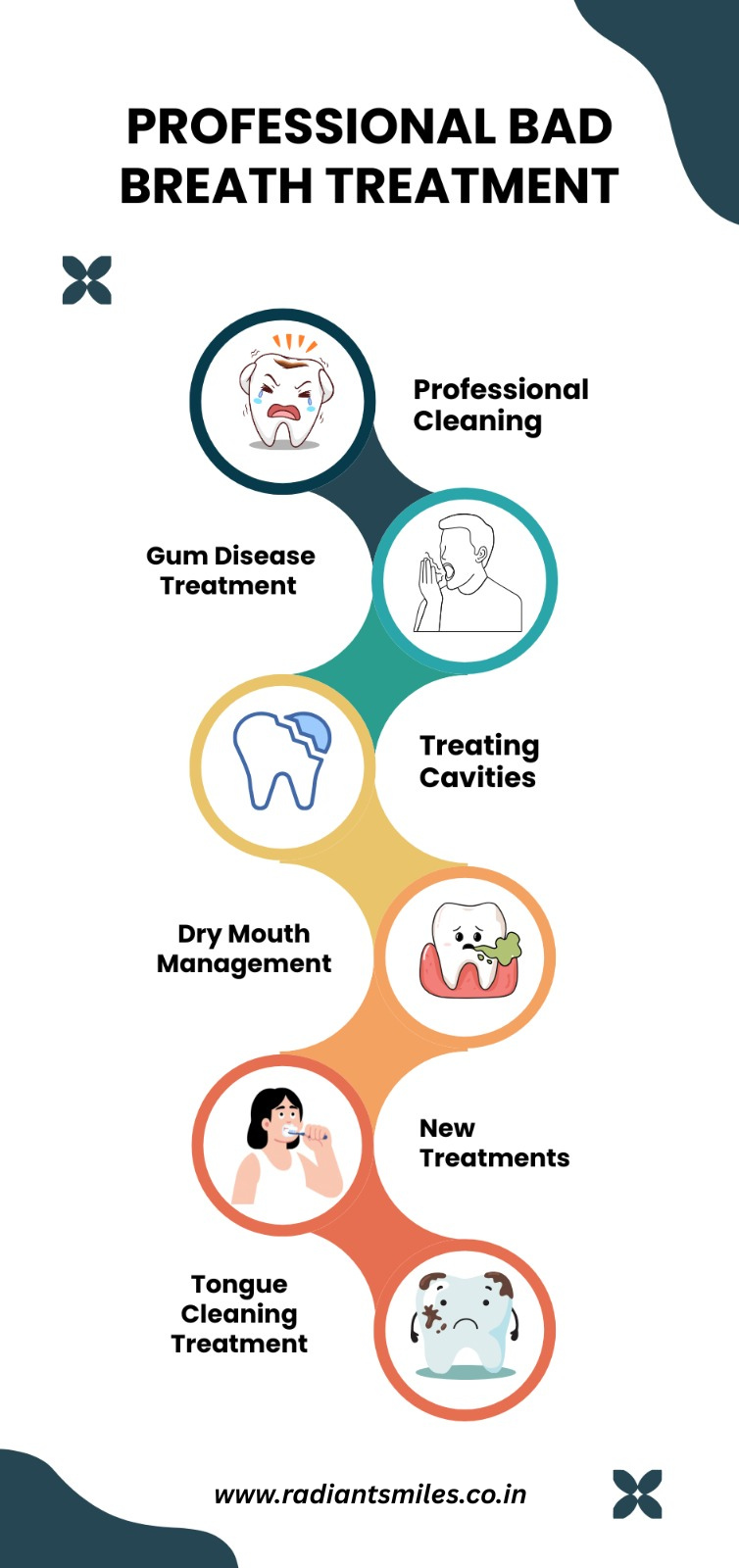
1. Professional Scaling and Cleaning
Tartar that has hardened onto tooth surfaces and below the gumline cannot be removed by brushing, regardless of technique or product. Professional scaling removes it using ultrasonic and hand instruments, eliminating a significant and continuous bacterial reservoir. Most patients with halitosis as a primary concern show noticeable improvement after a professional clean, particularly if scaling has been overdue. The professional teeth cleaning guide explains what the procedure involves and why the interval between cleans matters.
2. Gum Disease Treatment
For patients whose halitosis is driven by periodontal disease, scaling and root planing goes deeper than a standard clean, removing bacterial deposits from the root surfaces below the gumline and allowing the gum tissue to heal and reattach over subsequent weeks. In more advanced cases, periodontal surgery or referral to a periodontist may be needed. The gum disease treatment guide covers what that treatment involves and what to expect at each stage.
3. Treating Decay and Replacing Failing Restorations
Filling active cavities and replacing crowns or fillings that are leaking or cracked removes the bacterial traps driving odour from those specific sites. For patients where a particular tooth is the identified source, this is often the fastest and most complete resolution available.
4. Prescribed Rinses and Dry Mouth Management
For patients where dry mouth is the primary driver, a dentist can recommend specific antimicrobial rinses by ingredient type and, for more significant cases, refer to a GP for prescription saliva substitutes or medications that directly stimulate salivary gland function.
5. Emerging Treatments Worth Knowing About
Antimicrobial photodynamic therapy, which uses light combined with a photosensitive compound to reduce bacterial load on the tongue surface, is showing promising early results for persistent cases. Probiotics, particularly strains like Lactobacillus reuteri and Lactobacillus salivarius, have shown some improvement in measured odour scores in clinical trials, though a 2022 systematic reviewconcluded evidence is not yet sufficient for routine clinical recommendation. Both are worth mentioning as developing areas rather than established first-line treatments.
When to See a Doctor Instead of a Dentist
If a full dental assessment finds no oral cause, or if the breath odour has a character that doesn't fit the typical sulphurous pattern of bacterial halitosis, a GP or specialist is the right next step rather than more dental treatment.
GERD and acid reflux-related odour: GP or gastroenterologist. Tonsil stones or sinus-related odour: ENT specialist. Fruity breath with diabetes history: GP or endocrinologist. Ammonia-like or fishy odour with no dental cause: GP to rule out kidney or liver involvement.
The vast majority of patients don't reach this stage because the cause is oral. But knowing the referral pathway exists means that a patient with a non-dental cause isn't caught in a cycle of dental appointments that won't solve the problem. Missing tooth-related oral changes, which can also contribute to bacterial accumulation and gum health issues, are worth understanding too, and the guide on what happens when a missing tooth isn't replaced covers why adjacent gum and bone health matter beyond just the gap itself.
Why Chembur Patients Choose Radiant Smiles for Bad Breath Treatment
Halitosis assessments at Radiant Smiles start with finding the specific source rather than assuming a generic cause. The clinical approach covers tongue coating, gum pocket depth, the condition of existing restorations, and saliva quality before any treatment is recommended. Different causes need genuinely different responses, and treating the wrong one produces no improvement regardless of how thoroughly it's done.
The full range of treatments is available locally: professional scaling, gum disease management, restorative work, and rinse recommendations tailored to the individual case. Patients across Chembur, Ghatkopar, Govandi, Wadala, Sion, and Kurla can get a proper assessment and the right treatment without needing to travel across the city for something that can be resolved close to home.
Many patients who come in for a breath complaint are surprised to learn the specific source within the first appointment. Sometimes it's as targeted as a leaking crown on one molar. Sometimes it's years of tartar accumulation in a specific area that's been impossible to clean from the outside. Finding it is usually straightforward with a proper look. What takes longer is the management afterwards, and that's where having a clear treatment plan and realistic expectations makes all the difference.
Final Thoughts
Persistent bad breath has a cause, and in most cases that cause is something a dentist can find and fix in a few appointments. The daily routine matters, and tongue scraping in particular makes a measurable difference that most people don't discover until they actually try it properly. But for odour that returns despite consistent home care, professional treatment goes further than anything available over the counter.
Book a bad breath assessment at Radiant Smiles, Chembur, get a clear picture of what's causing it, and find out the fastest route to fixing it for good.
Frequently Asked Questions
1. What causes constant bad breath even after brushing?
Persistent halitosis after brushing almost always means the source isn't on the tooth surfaces that brushing reaches. The most common culprits are tongue coating at the back of the tongue where brushing rarely gets to, early gum disease creating bacterial pockets below the gumline, a leaking or broken filling, or reduced saliva flow allowing bacteria to multiply between brush cycles. A dental assessment identifies which one quickly.
2. Can gum disease cause bad breath?
Yes, and it's one of the most common causes of chronic halitosis in adults. As gums pull away from teeth, deep pockets form that fill with anaerobic bacteria producing volatile sulfur compounds continuously. The odour is persistent and distinctive, and it won't improve with better brushing because home care cannot reach below the gumline. Professional scaling and gum treatment are what's needed.
3. How do dentists treat chronic bad breath?
The treatment depends entirely on what's driving it. Professional scaling removes tartar and bacteria from below the gumline that home care can't reach. Active gum disease or decay is treated to eliminate the bacterial source directly. Specific antimicrobial rinses containing zinc, chlorhexidine, or stannous fluoride are recommended where appropriate. Dry mouth as the primary driver may need prescribed saliva support. Identifying the cause correctly is what determines which treatment actually works.
4. Does tongue cleaning really help with bad breath?
Yes, and meaningfully so. A 2019 randomised clinical trial found that tongue scraper users had significantly lower measured volatile sulfur compound levels than those using mouthwash alone. The back of the tongue has a papillary surface that traps bacteria far more effectively than smooth surfaces do, and a dedicated scraper reaches that area and removes the biofilm more effectively than toothbrush bristles. It's one of the most impactful changes most people with halitosis haven't tried properly yet.
5. When should I see a doctor instead of a dentist for bad breath?
If a dental assessment finds no oral cause, or if the breath has a distinctly fruity, sour, ammonia-like, or fishy character rather than the sulphurous smell typical of bacterial halitosis, a GP referral is the right next step. Conditions including GERD, diabetes, tonsil stones, sinus infections, and in rare cases kidney or liver disease can all produce breath odour that no dental treatment will resolve because the source isn't in the mouth at all.
Dr. Ligi Elsa John
BDS, MDS — Periodontist, Implantologist & Smile Designing Specialist
Dr. Ligi has established herself as a remarkable periodontist, implantologist, and smile design specialist. She holds a Bachelor of Dental Surgery (BDS) from Bharati Vidyapeeth Deemed University, Navi Mumbai, and pursued her post-graduate studies at Terna Dental College, Navi Mumbai. With over 12 years of experience, she has become a respected name in her field.
Since 2019, Dr. Ligi has been a dedicated Senior Associate Dentist at Radiant Smiles Dental Clinic, where her role extends beyond clinical excellence into administration and day-to-day patient care coordination. Known for her patient-centric approach, she is passionate about creating beautiful, confident smiles for every patient who walks through our doors.
Book an Appointment with Dr. Ligi Elsa John