



When Is the Best Time to Treat a Cavity? Early Signs You Shouldn’t Ignore (2026 Guide)

Cavities often begin silently, without pain, which is why they are easy to ignore. The best time to treat a cavity is as early as possible, when it’s still in the enamel stage and may even be reversible. Early signs like white spots, mild sensitivity, or slight discoloration shouldn’t be overlooked. If ignored, decay progresses deeper, leading to pain, infection, and more complex treatments like root canals. Acting early keeps treatment simple, quick, and often painless. Regular check-ups and good oral hygiene play a key role in catching problems early and protecting your natural teeth long-term.
Tooth decay rarely starts with pain, and that is exactly why it gets overlooked. By the time discomfort shows up, the problem has often moved beyond the earliest stage.
In many cases, early decay, known as demineralization, can be managed without drilling if detected in time. The challenge is that most people wait. A faint spot, slight sensitivity, or occasional discomfort is easy to ignore. Weeks or months later, that same tooth may need a filling or even a root canal.
This pattern is seen every day in clinical practice. The window for simple treatment exists, but it often passes unnoticed.
Understanding when to treat cavities is not just about timing. It is about protecting natural tooth structure, keeping treatments simple, and avoiding unnecessary discomfort. At Radiant Smiles Dental Clinic, the focus remains on early detection and preventive care so that small problems are managed before they become complex ones.
Understanding How Cavities Develop
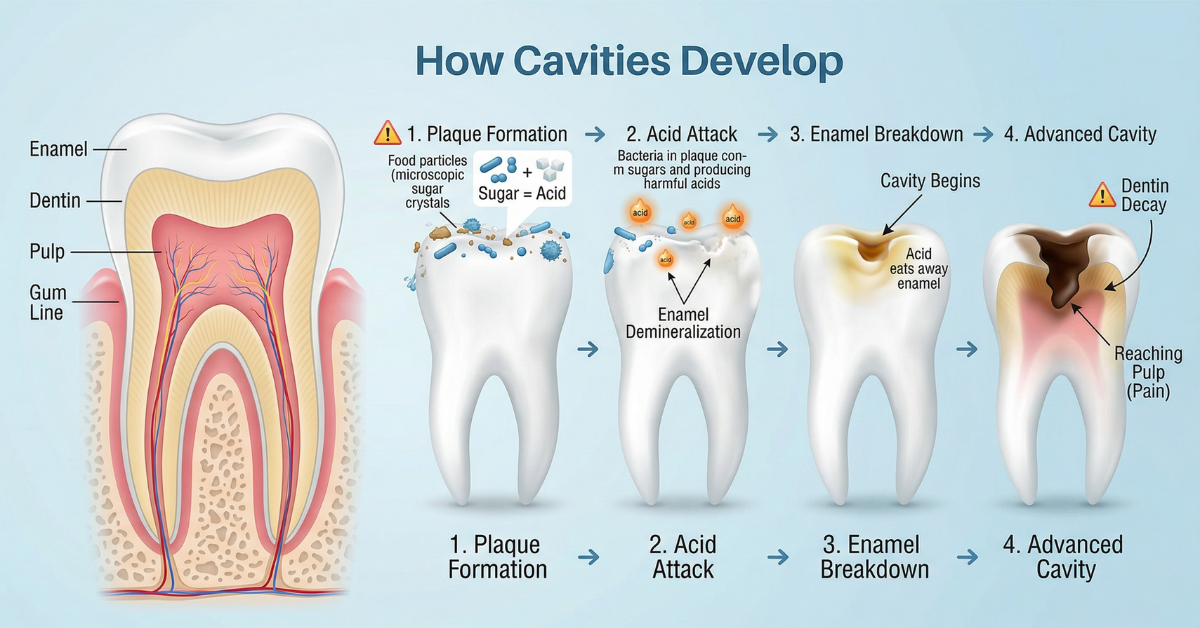
Teeth are not a single solid structure. They are made up of three layers, each with a specific role:
- Enamel: The hard outer layer that protects the tooth
- Dentin: A softer, yellowish layer beneath enamel with tiny tubules
- Pulp: The inner core containing nerves and blood supply
Cavities usually begin in the enamel. At this stage, there may be only a faint white or brown spot or a slightly rough surface. There is no pain, no sensitivity, and often no reason for concern from a patient’s point of view.
As decay moves into the dentin, things start to change. Sensitivity to cold, sweet, or hot foods may develop because dentin is more porous and connected to the nerve.
If the decay reaches the pulp, it becomes a more serious problem. Pain can become persistent, and treatment often involves a root canal rather than a simple filling.
This progression is why early cavity treatment matters. The earlier the problem is identified, the simpler, more comfortable, and more conservative the treatment tends to be.
When to Treat Cavities: The Ideal Timing
The ideal time to treat a cavity is as soon as it is detected, ideally before a visible hole forms. At this stage, the focus is on stopping progression rather than repairing damage.
Early treatment makes a clear difference:
- Minimal removal of natural tooth structure
- Faster and often painless cavity treatment
- Lower cost compared to advanced procedures
- Reduced risk of infection and complications
When decay is limited to the enamel, treatment may not require drilling at all. Remineralization therapies, fluoride applications, or sealants can help reverse or stabilize the damage.
As the cavity progresses deeper, treatment becomes more invasive. What could have been managed conservatively may then require fillings, root canal treatment, or even tooth replacement in advanced cases. Early action keeps care simple, comfortable, and predictable.
Early Signs of Tooth Decay You Shouldn’t Ignore
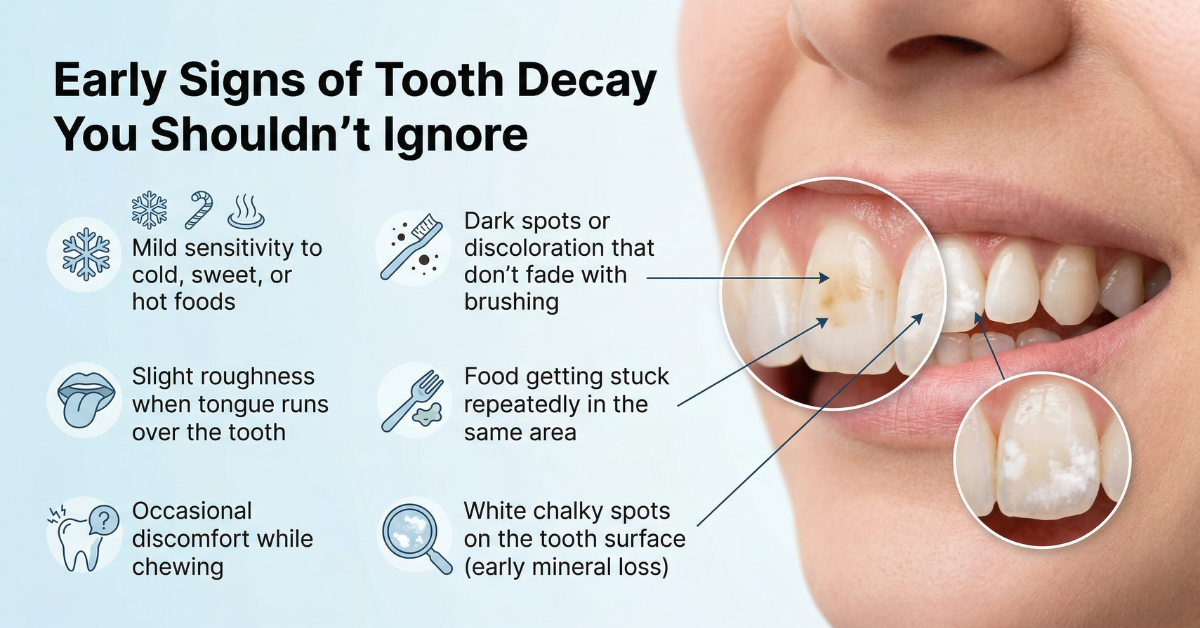
Recognizing early signs of tooth decay can prevent the need for more complex treatments later. In the initial stages, the changes are subtle and often easy to overlook.
Common early warning signs include:
- White chalky spots on the tooth surface, indicating early mineral loss
- Dark spots or discoloration that do not fade with brushing
- Mild sensitivity to cold, sweet, or hot foods
- Slight roughness felt when the tongue runs over the tooth
- Food getting stuck repeatedly in the same area
- Occasional discomfort while chewing
A key clinical observation is the presence of a slight “catch” during dental examination. This indicates the beginning of decay, even when there are no symptoms.
This stage is critical. Treatment at this point is usually quick, simple, and conservative, often preventing the need for fillings or more invasive procedures.
What Happens If You Wait Too Long?
Delaying treatment changes the entire course of tooth decay. What starts as a simple, manageable issue can progress into a complex and painful condition.
Stage-by-Stage Progression
Enamel Stage (Silent Phase)
- No pain or obvious symptoms
- Damage may be reversible in some cases
- Best stage for early intervention
Dentin Stage (Sensitivity Begins)
- Noticeable sensitivity to hot, cold, or sweet foods
- Decay spreads more quickly
- Typically requires a filling
Pulp Stage (Painful Phase)
- Persistent or severe pain
- Increased risk of infection
- Root canal treatment often required
Advanced Infection (Emergency Phase)
- Swelling, abscess formation
- Possible tooth loss
- More complex and costly treatment
The takeaway is straightforward. The longer treatment is delayed, the more invasive, time-consuming, and expensive it becomes. Early care keeps treatment simple and predictable.
Real Consultation Scenario: What Patients Often Experience
A situation frequently seen in clinics begins with something minor. A young adult notices a small blackish discoloration on a molar but ignores it because there is no pain.
Over time, mild sensitivity starts to appear. By the time treatment is finally sought, the decay has already reached the dentin.
What could have been managed with a quick, simple, and often painless procedure now requires anesthesia and a more extensive restoration.
This pattern highlights an important clinical truth: pain is not the beginning of a cavity. It is a late-stage signal.
Modern Approaches to Painless Cavity Treatment (2026)
Modern dentistry is centered on preserving natural tooth structure and intervening as early as possible. When decay is detected in its initial stages, treatment can often be simple, conservative, and comfortable.
Early-stage solutions include:
- Fluoride treatments to strengthen enamel and slow or reverse early decay
- Remineralization therapies that help restore lost minerals in the enamel
- Sealants to protect deep grooves in molars that are prone to cavities
- Minimally invasive fillings for small, localized areas of decay
These approaches make painless cavity treatment a realistic expectation when intervention happens early. In many cases, discomfort is minimal or completely avoided.
Advanced diagnostic tools also play a key role. Modern technology allows dentists to detect cavities at a stage when they are not yet visible to the eye, significantly improving treatment outcomes and reducing the need for invasive procedures.
Prevention: How to Avoid Cavities in the First Place
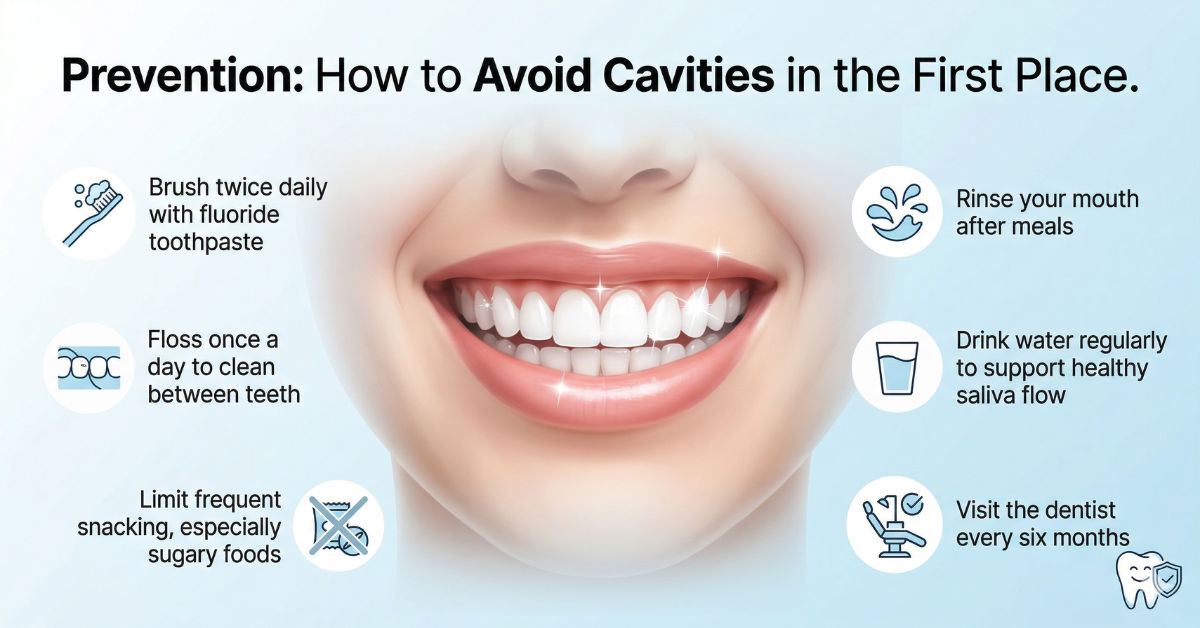
Prevention remains the most effective way to manage tooth decay. Consistent daily habits protect enamel and reduce the chances of cavities developing in the first place.
Practical daily habits:
- Brush twice daily with fluoride toothpaste
- Floss once a day to clean between teeth
- Limit frequent snacking, especially sugary foods
- Rinse your mouth after meals
- Drink water regularly to support healthy saliva flow
- Visit the dentist every six months
For children and individuals prone to cavities, preventive treatments such as fluoride varnish and dental sealants provide an added layer of protection. These measures strengthen enamel and help shield vulnerable areas from decay.
When Should You See a Dentist?
Waiting for pain is one of the most common mistakes in dental care. A visit should be scheduled as soon as early changes are noticed, even if they seem minor. Signs such as new discoloration, sensitivity that was not present before, food getting stuck repeatedly in the same area, or a rough surface felt with the tongue can all indicate the beginning of decay.
These changes often appear before any pain develops, which is why they are easy to ignore. Routine dental check ups remain the most reliable way to detect early decay and manage it before it progresses.
At Radiant Smiles Dental Clinic, the focus is on early diagnosis, preventive care, and minimally invasive treatment. Timely evaluation helps keep treatment simple, comfortable, and effective while preserving natural tooth structure.
Conclusion: Act Early, Stay Ahead
Cavities do not start with pain. They start quietly, often unnoticed, and progress steadily if ignored.
The best time to act is always early. Early cavity treatment protects your natural tooth, reduces treatment time, and keeps the experience comfortable.
Delaying care turns a small, manageable issue into a complex dental problem. But the good news is that timely action changes everything.
If you notice even the smallest sign, do not wait for it to worsen.
Book a dental check-up atRadiant Smiles Dental Clinic and catch the problem early, while treatment is still simple, quick, and stress-free.
Frequently Asked Questions
1. When is the best time to treat a cavity?
The best time is at the earliest stage, when decay is limited to the enamel and before any pain begins. Early treatment helps avoid more complex procedures.
2. What are the early signs of tooth decay?
Common signs include white chalky spots, discoloration, mild sensitivity, rough tooth surfaces, and food getting stuck in specific areas.
3. Can cavities be treated without pain?
Yes. When detected early, cavity treatment is usually quick, simple, and painless with modern dental techniques.
4. How long can I wait before treating a cavity?
It is not recommended to wait. Cavities progress over time and can lead to more invasive and costly treatments if delayed.
5. Is tooth sensitivity always a sign of a cavity?
Not always, but it is a common early warning sign. Any new or persistent sensitivity should be evaluated by a dentist to rule out decay or other issues.
The Instagram reel below gives a quick, easy-to-follow explanation:
Dr. Shalini Sharma
MDS (Conservative Dentistry & Endodontics) — Endodontist
Dr. Shalini, a distinguished endodontist, completed her post-graduation in Conservative Dentistry and Endodontics from HNB University. Her dedication and expertise have made her an integral part of Apollo Dental Clinics and a sought-after consultant across South Bombay, Navi Mumbai, and Thane.
She excels in painless root canal therapy, often completing treatments in a single sitting, with specialisations in curved canals, re-root canal treatments, post and core restorations, apicoectomies, and complex root surgeries. She is also highly skilled in esthetic dentistry and smile designing. Since 2022, Dr. Shalini has been a valued member of the Radiant Smiles team, known for combining technical proficiency with genuine, compassionate care.
Book an Appointment with Dr. Shalini Sharma