


How Intraoral Scanners Speed Up Crowns & Bridges: Faster, More Accurate, Eco-Friendly Dentistry
For years, getting a dental crown or bridge meant biting into a tray filled with thick impression material and waiting nearly a week for the final restoration. Today, that experience has changed dramatically. With the rise of digital dentistry in India, more advanced clinics are adopting intraoral scanners for crowns and bridges to improve accuracy, comfort, and speed.
Recent industry data suggests that digital scanning can reduce crown turnaround time by up to 40 percent, while significantly lowering remakes caused by impression errors. For patients, this means fewer visits, faster dental crowns with intraoral scanning, and a more comfortable overall experience.
At Radiant Smiles Dental Clinic, digital workflows are part of delivering modern, precise, and patient-friendly care. Whether we like it or not, digital dentistry is the way forward, and a scanner is one of the first tools needed in any clinical armamentarium to begin the digital dentistry journey.
What Is an Intraoral Scanner and Why It Matters for Crowns and Bridges

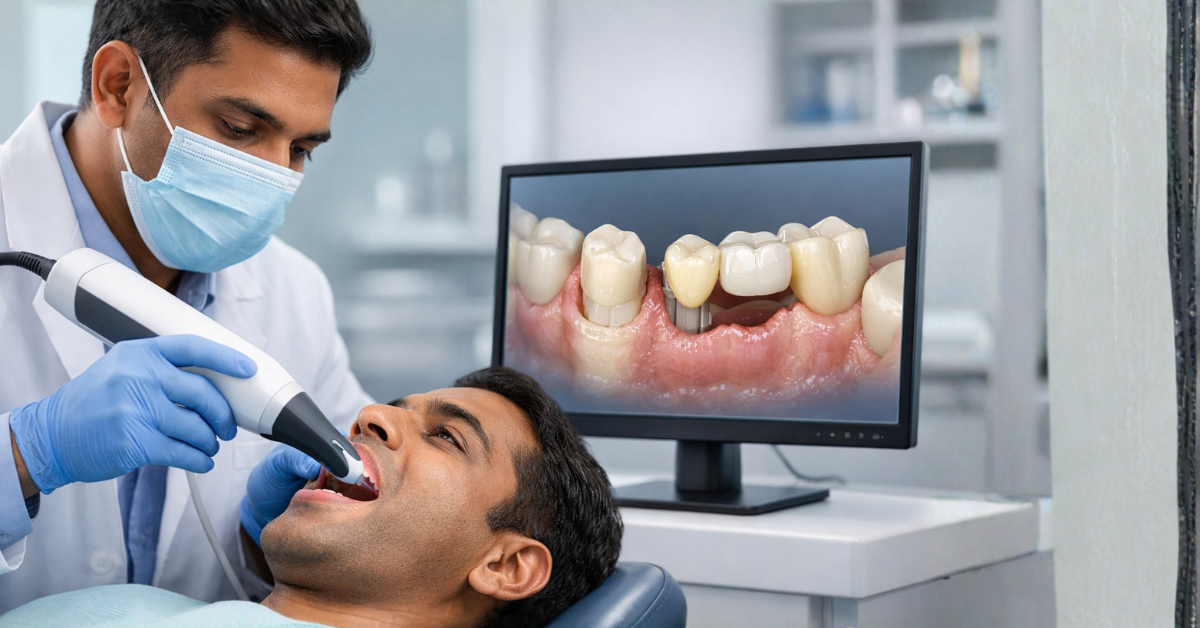
An intraoral scanner is a handheld digital device that captures highly detailed 3D images of teeth and surrounding tissues. Instead of placing trays filled with impression material inside the mouth, the scanner records thousands of images per second and instantly converts them into a precise digital model. The result is a clean, accurate representation of the patient’s oral structures without discomfort or distortion.
Why This Matters for Crowns and Bridges

When preparing a tooth for a crown or designing a bridge, precision is critical. Even minor inaccuracies in traditional impressions can lead to:
- Poor marginal fit
- Bite discrepancies
- Repeated chairside adjustments
- Crown remakes
With intraoral scanner crowns and bridges, the digital model significantly improves accuracy and reduces technique-related errors. The scanner allows real-time verification, ensuring margins and preparation details are clearly captured before the case moves to fabrication.
This level of precision not only improves restoration fit but also enhances long-term durability and patient satisfaction.
Digital Dentistry Intraoral Scanner Benefits: Accuracy, Speed and Comfort
For many patients, the biggest surprise with digital dentistry is how smooth the process feels compared to traditional impressions. No trays filled with material. No waiting for it to set. No repeat attempts because something distorted.
From a clinical perspective, accuracy is where intraoral scanning truly stands out. Traditional impressions can shrink, tear, or capture tiny air bubbles that affect the final fit of crowns and bridges. A digital scan captures detailed margins and bite relationships in real time. This reduces errors and improves how precisely the final restoration fits. In many cases, crowns that once required multiple adjustment visits now seat correctly at the first appointment.
Speed is another major advantage. Earlier, turnaround times often stretched to a week due to impression transport and laboratory coordination. With digital files sent instantly to the lab, crowns are commonly ready within a few days. In advanced setups, same day restorations are possible. For patients balancing busy schedules, this efficiency matters.
Comfort is equally important. The scanner is minimally invasive, reduces gag reflex, and shortens chair time. For children, elderly patients, or anyone anxious about dental treatment, that difference is significant. Digital workflows are not just about technology. They are about delivering care that feels precise, efficient, and patient focused.
Eco-Friendly Dental Technology: Why It Matters

Patients today are more aware of environmental impact than ever before, and healthcare is no exception. Traditional impression techniques rely on silicone materials, disposable plastic trays, packaging supplies, and physical courier transport to send models to laboratories. Each step adds to clinical waste and carbon footprint.
Digital workflows change that equation. Intraoral scanning removes the need for most impression materials and eliminates shipping of physical models. Files are transferred instantly to the laboratory, reducing packaging waste and transportation-related emissions. The result is a cleaner, more efficient process that supports eco-friendly dental technology without compromising precision or clinical outcomes.
Sustainability in dentistry is not about following a trend. It reflects responsible, forward-thinking healthcare. When advanced technology can deliver higher accuracy, improved patient comfort, and reduced environmental burden at the same time, it represents meaningful progress for both patients and the profession.
Real Consultation Scenario: A Practical Perspective
Consider a patient who requires a crown after root canal treatment. With traditional impressions, even a minor distortion can lead to a slightly high bite. This often means additional chairside adjustments at the time of crown insertion, and sometimes patient discomfort for a few days.
With digital scanning, the process is more controlled. Margins are clearly visible on the screen, allowing immediate verification. If any area is unclear, it can be rescanned instantly. The laboratory receives precise digital data, reducing guesswork. In many cases, the crown fits accurately at the first placement, with minimal or no adjustment required.
In another scenario, a patient replacing an old bridge had previously experienced multiple remakes due to impression inaccuracies at a different clinic. After transitioning to a digital workflow, the new bridge was completed in fewer visits and required only minor refinement.
These practical experiences highlight how intraoral scanner crowns and bridges improve precision, reduce treatment delays, and enhance overall patient satisfaction.
Improved Communication and Diagnostics
One of the most valuable yet often overlooked advantages of digital scanning is transparency. As the scan progresses, a detailed 3D model appears on the screen in real time. Patients are not just told what is happening. They can actually see it.
The scan allows clear visualization of:
- Cracked cusps
- Decay margins
- Gum levels and tissue health
- Bite alignment
This level of visual communication improves patient understanding and builds trust. When patients can see the condition of their teeth on screen, treatment recommendations feel clearer and more logical, leading to better acceptance and informed decisions.
Digital files are also securely archived, creating a precise record over time. Wear patterns, gum recession, and the stability of existing restorations can be monitored more accurately during follow-up visits. This makes long-term care more structured, measurable, and proactive rather than reactive.
Are Intraoral Scanners Suitable for Everyone?
While digital scanning works exceptionally well in most crown and bridge cases, certain complex scenarios, such as extensive subgingival margins or significant bleeding, may require additional techniques for optimal results.
A thorough clinical evaluation determines the best approach. Safety, long-term stability, and proper occlusion always take priority over speed.
Conclusion: The Future of Crowns and Bridges Is Digital
Intraoral scanning is transforming restorative dentistry. From greater precision and reduced remakes to faster dental crowns with intraoral scanning and eco-friendly dental technology, the benefits are clear.
Digital dentistry intraoral scanner benefits go beyond convenience. They improve accuracy, enhance patient comfort, streamline lab communication, and support sustainable practice.
At Radiant Smiles Dental Clinic, embracing modern technology ensures patients receive faster, more predictable, and comfortable crown and bridge treatments.
Book a consultation today and experience how digital dentistry can make your next restoration quicker, cleaner, and more precise.
Take a quick look at the Instagram reel below for a visual guide:
https://www.instagram.com/reel/DGQndfWoepU/?igsh=dmxvc3YwM3lveXdz
Frequently Asked Questions
1. How accurate are intraoral scanners for crowns and bridges?
Intraoral scanners capture highly detailed 3D images, minimizing distortion and margin errors commonly seen with traditional impressions. This results in better-fitting restorations and fewer chairside adjustments.
2. Do digital scans reduce crown delivery time?
Yes. Digital files are transferred instantly to the laboratory, often reducing turnaround time from five to seven days to approximately three days, depending on the lab workflow.
3. Is intraoral scanning more comfortable than traditional impressions?
Most patients report significantly greater comfort. The process eliminates bulky trays and impression materials, reduces gag reflex, and shortens chair time.
4. Is this technology environmentally friendly?
Digital workflows reduce the need for disposable trays, silicone materials, packaging, and physical shipping. This supports eco-friendly dental technology while maintaining high clinical standards.
5. Are intraoral scanners safe?
Intraoral scanners use non-invasive optical technology. They do not emit harmful radiation and are safe for both children and adults when operated by trained dental professionals.