


Lingual Braces vs Clear Aligners: Which Is Better for You?

Quick Answer
Both are invisible options for adults, but they work differently:
- What they are: Lingual braces are fixed metal braces placed behind your teeth. Clear aligners are removable transparent trays.
- Visibility: Both are discreet. Clear aligners are almost invisible from the front, lingual braces are 100% invisible from the front because they are hidden behind teeth.
- Comfort: Clear aligners are more comfortable initially. Lingual braces can irritate the tongue for the first few weeks.
- Best for complex cases: Lingual braces handle severe crowding, bite issues, and rotations better. Clear aligners are best for mild to moderate cases.
- Treatment time: Lingual braces - 12 to 24 months. Clear aligners - 6 to 18 months depending on discipline.
- Food & Hygiene: Clear aligners are removable so you can eat anything and brush easily. Lingual braces are fixed, and need extra cleaning.
- Cost: Lingual braces cost more than clear aligners due to custom fabrication and specialist skill.
Introduction
Deciding to straighten crooked or misaligned teeth as an adult often comes with a second decision right behind the first: which type of treatment actually fits a working professional's life, budget, and comfort level. Lingual braces and clear aligners are both marketed as the "invisible" option, but they work in very different ways, suit different kinds of cases, and come with noticeably different price tags. This guide compares both honestly, so the choice feels informed rather than guessed at.
Lingual Braces vs Clear Aligners at a Glance
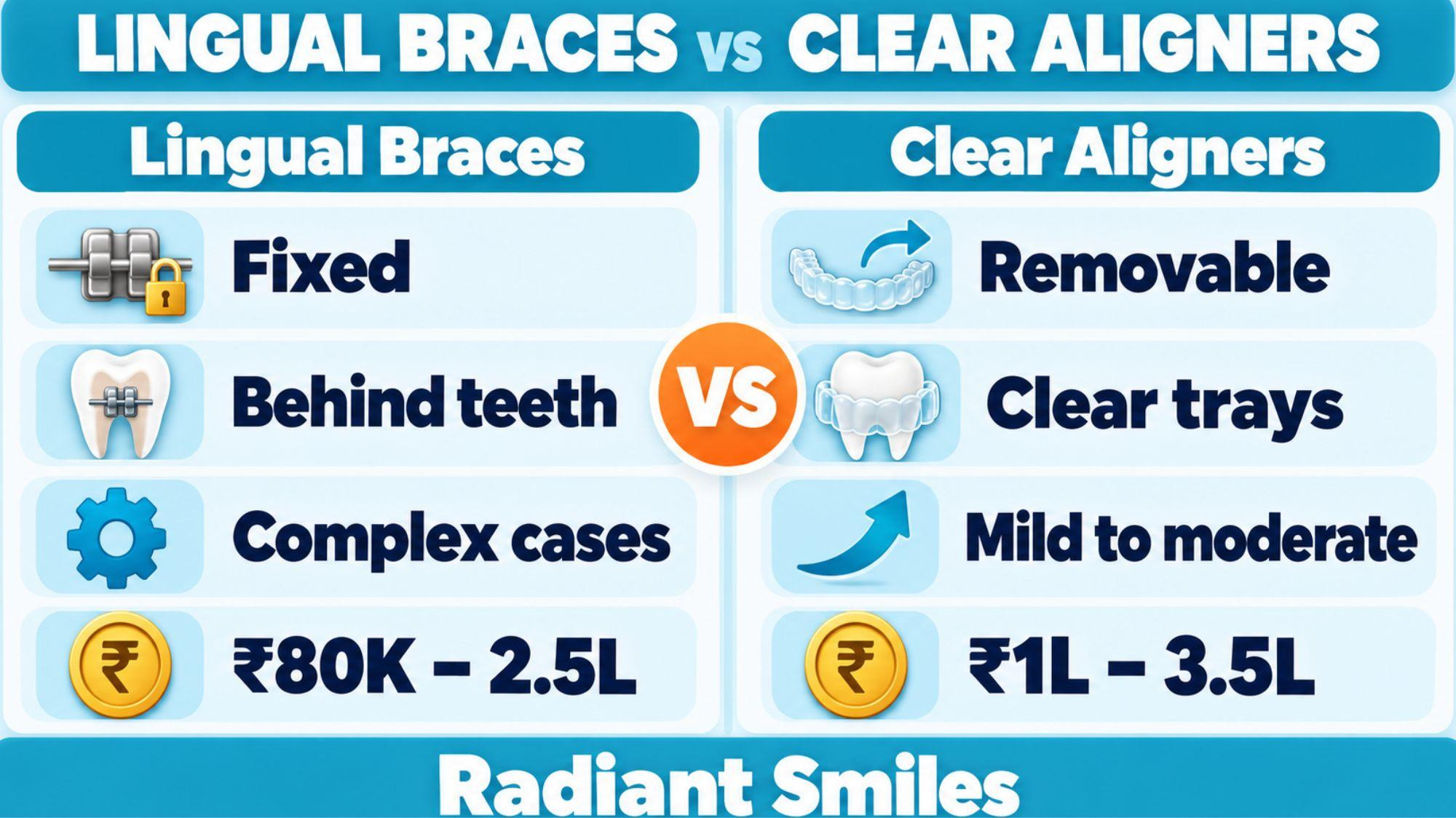
Lingual braces are fixed, wire-based braces attached to the back of the teeth, making them invisible from the front while working much like traditional braces. Clear aligners are a series of removable, custom-made clear trays that gradually shift teeth, offering more flexibility but requiring more patient discipline to work effectively.
| Factor | Lingual Braces | Clear Aligners |
|---|---|---|
| Visibility | Hidden behind teeth, invisible from front | Nearly invisible, clear plastic |
| Removable? | No, fixed in place | Yes, removable for eating and brushing |
| Best For | Complex cases, patients wanting a fixed solution | Mild to moderate cases, patients wanting flexibility |
| Speech Impact | Noticeable adjustment period, more than aligners | Minimal |
| Treatment Time | Similar to traditional braces, case-dependent | Often similar, but compliance-dependent |
| Price Range (₹) | 80,000 – 2,50,000 | 1,00,000 – 3,50,000 |
Types of Braces Explained
Before comparing lingual braces and clear aligners specifically, it helps to see where each sits among the full range of orthodontic options.
✔ Metal Braces The traditional option: metal brackets and wires, visible but typically the most budget-friendly, and often the most efficient for complex movements.
✔ Ceramic Braces — Function like metal braces but use tooth-colored or clear brackets, making them less noticeable while still being a fixed, wire-based system.
✔ Lingual Braces — Fixed braces placed on the back (tongue side) of the teeth, invisible from the front while still offering the control of a traditional wire-based system.
✔ Clear Aligners — Removable, custom-fitted clear trays that gradually shift teeth without any brackets or wires at all.
What Are Lingual Braces?
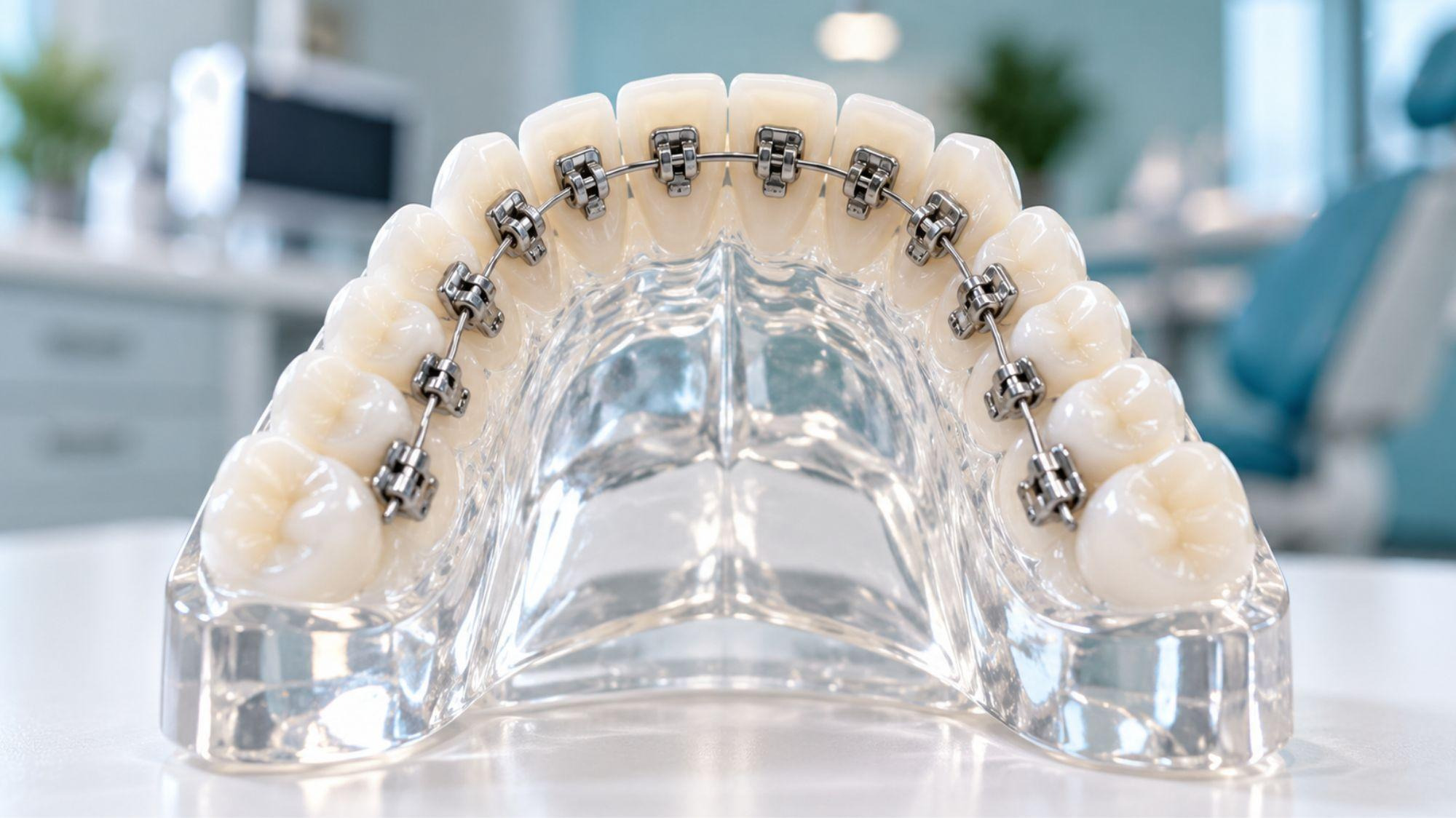
Lingual braces work exactly like traditional metal or ceramic braces, brackets and wires that apply steady pressure to move teeth over time, except they're bonded to the inner (tongue-facing) surface of the teeth rather than the front. This makes them completely invisible when smiling or talking face-to-face, while still offering the same level of control over complex tooth movements that fixed braces are known for.
Who do lingual braces suit? Lingual braces tend to suit patients with more complex alignment issues who still want an invisible option, since they offer more precise control than removable aligners for certain tooth movements. They also suit patients who may not be fully reliable about wearing removable aligners for the required hours each day, since lingual braces stay in place regardless of daily compliance.
The main adjustment period involves speech, because the brackets sit close to the tongue, some patients notice a lisp or altered speech pattern for the first few weeks, which generally improves as the tongue adapts.
What Are Clear Aligners?
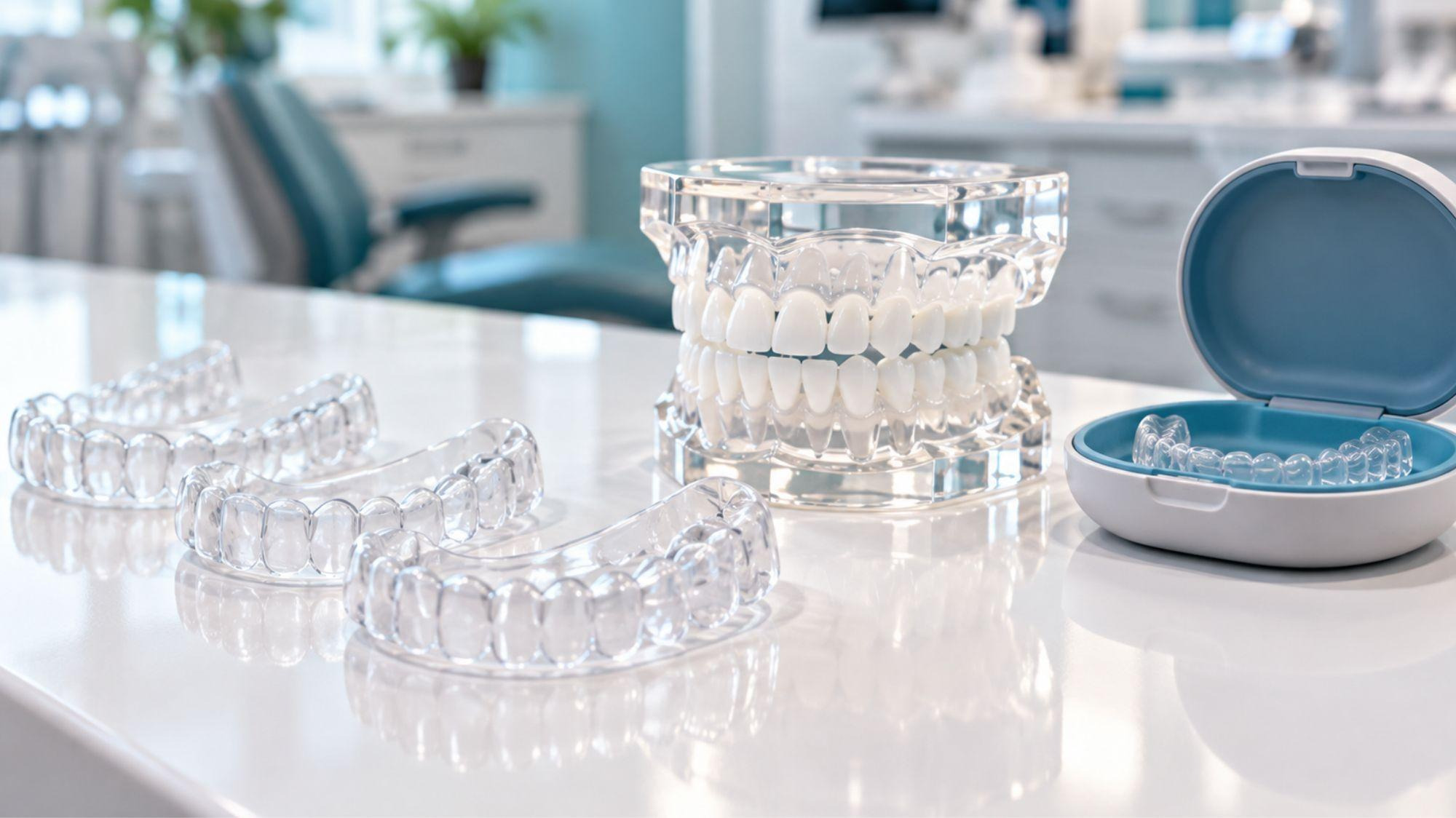
Clear aligners are a series of custom-made, clear plastic trays, each worn for one to two weeks before moving to the next in the series, with each tray making small, gradual adjustments to tooth position. Unlike lingual braces, they're fully removable, which means they come out for eating, brushing, and flossing.
Who does a clear aligners suit? Clear aligners generally suit patients with mild to moderate misalignment, crowding, gaps, or minor bite issues, and patients who want the flexibility to remove them for meals and special occasions. They require real discipline, though: effectiveness depends on wearing them for roughly 20 to 22 hours a day, and inconsistent wear can meaningfully slow down or compromise treatment results.
Cost Comparison in Mumbai
Cost is often the deciding factor once both options are otherwise on the table, and the gap between them is real enough to matter for most patients.
| Type of Treatment | Price Range (₹) |
|---|---|
| Metal Braces | 20,000 – 80,000 |
| Ceramic Braces | 30,000 – 1,50,000 |
| Lingual Braces | 80,000 – 2,50,000 |
| Clear Aligners | 1,00,000 – 3,50,000 |
Clear aligners generally sit at the higher end of the cost range compared to lingual braces, largely due to the custom manufacturing of each individual tray in the series. The exact cost for either option depends on case complexity, the number of aligner sets or the length of lingual treatment needed, and whether additional procedures like interproximal reduction (IPR) or extractions are required beforehand, all of which the treating orthodontist will outline during consultation.
Comfort, Speech, Eating and Hygiene Compared
Comfort: Lingual braces can feel more irritating to the tongue initially, simply due to their placement, while clear aligners are generally considered more comfortable from the start since there are no brackets or wires involved.
Speech: Lingual braces have a more noticeable impact on speech in the first few weeks, given their position close to the tongue. Clear aligners have minimal speech impact for most patients.
Eating: Clear aligners are removed before eating, so there are no food restrictions at all. Lingual braces, being fixed, come with similar food precautions to traditional braces, avoiding very hard or sticky foods that could damage the brackets.
Hygiene: Clear aligners make brushing and flossing straightforward, since they're removed first. Lingual braces require more careful cleaning around the brackets and wires, similar to traditional braces, though their position on the back of the teeth can make them slightly trickier to clean than front-facing braces.
Treatment Time and Complex Cases
For straightforward cases, treatment time between lingual braces and clear aligners is often broadly similar, though this varies significantly by individual case. Where the two diverge is in complexity: lingual braces, like traditional braces, tend to handle more complex bite issues and significant tooth rotations more predictably than clear aligners, which work best within a narrower range of mild to moderate misalignment.
When are aligners not enough? Cases involving significant bite correction, severe crowding, or certain types of rotation may not be fully addressed by aligners alone, and the orthodontist may recommend lingual or traditional braces instead, or, in some cases, a combination approach starting with fixed braces before finishing with aligners.
Which Is Better for You? A Short Decision Guide
Neither option is universally better, the right choice depends on the specific case and what matters most to the individual patient.
✔ Choose lingual braces if: the case is more complex, consistency with removable trays feels unrealistic, or a completely fixed, no-maintenance-decisions-required option is preferred.
✔ Choose clear aligners if: the case is mild to moderate, flexibility around eating and social situations matters, and daily discipline to wear trays for the required hours is realistic.
✔ Either way: the only way to know which fits a specific case is a proper orthodontic evaluation, what looks straightforward on paper can shift once X-rays and a physical exam are involved.
What to Expect at an Orthodontic Consultation at Radiant Smiles
A first orthodontic consultation typically starts with a dental checkup to assess overall oral health, since treating any existing decay or gum issues usually comes before orthodontic planning begins. From there, the orthodontist reviews X-rays and digital scans, discusses the case in plain language, and walks through which treatment options are realistic given the specific alignment issue, along with a clear cost estimate before any commitment is made.
Conclusion
Lingual braces and clear aligners both offer a way to straighten teeth without visible metal brackets, but they suit different situations, lingual braces for more complex cases or patients who prefer a fixed solution, clear aligners for milder cases and those who value flexibility. The right choice comes down to the specific case, which only becomes clear with a proper orthodontic evaluation. Book your Orthodontic Consultation at Radiant Smiles, Mumbai
Frequently Asked Questions
Are lingual braces more expensive than clear aligners?
Generally, no, lingual braces tend to cost somewhat less than clear aligners in Mumbai, though both are priced at the higher end of orthodontic options compared to metal or ceramic braces.
Do lingual braces affect speech permanently?
No, most patients notice a temporary speech adjustment in the first few weeks as the tongue adapts to the brackets, which typically resolves on its own with time.
Can clear aligners fix all types of misalignment?
No, clear aligners work best for mild to moderate misalignment. More complex bite issues or significant rotations may require lingual or traditional braces, which the orthodontist can assess during consultation.
How long does treatment take with lingual braces vs clear aligners?
Treatment time varies by case rather than by the type of appliance alone, though both options are generally comparable for similar levels of complexity the orthodontist can give a case-specific estimate after examination.
Which option requires more discipline from the patient?
Clear aligners require more daily discipline, since they must be worn 20 to 22 hours a day to work as intended. Lingual braces, being fixed, don't depend on daily compliance in the same way.
Dr. Shaili Shah
BDS, MDS (Orthodontics & Dentofacial Orthopaedics) — Orthodontist
Dr. Shaili Shah is a distinguished Consulting Orthodontist with extensive expertise in Orthodontics and Dentofacial Orthopaedics. She earned her BDS from Dr. D Y Patil Dental College and Hospital, Navi Mumbai in 2009, and pursued her MDS in Orthodontics and Dentofacial Orthopaedics under the Maharashtra University of Health Sciences. She has further enhanced her skills in Medical Cosmetology and Aesthetics under the guidance of renowned dermatologist Dr. Jamuna Pai.
As an Invisalign Certified and Invisible Braces Specialist, Dr. Shah brings precision and a holistic, smile-design focused approach to every case. Her contributions to the field include award-winning paper presentations and multiple publications in esteemed dental journals. Beyond the clinic, she is a passionate social activist, conducting free dental check-ups and oral hygiene lectures for underprivileged communities.
Book an Appointment with Dr. Shaili Shah