


Full Mouth Dental Implants in Mumbai: Cost & Procedure
Key takeaways
- Full mouth implants cost ₹3.5–5.5 lakh per jaw for All-on-4, ₹4.5–7 lakh for All-on-6, and ₹7–12 lakh for both jaws with a zirconia bridge.
- All-on-4 uses 4 angled implants, and works with moderate bone loss. All-on-6 adds 2 more for greater long-term stability and suits patients with good bone density.
- Most patients go from consultation to final teeth in 3–6 months; immediate loading means some patients leave with temporary fixed teeth within 1–3 days of surgery.
- Bone grafting (₹10,000–25,000 per site), sinus lifts, sedation, and extractions are often priced separately, always asking for an itemised quote before comparing clinics.
- Clinical literature reports success rates above 95% at 10 years with proper maintenance.
- Significant bone loss does not automatically rule out treatment, zygomatic implants and grafting make implants possible for most cases.
For most people, the journey to full mouth dental implants doesn't begin with a Google search for "All-on-4 implants" or "zirconia bridges." It begins much earlier, with small frustrations that slowly become part of everyday life.
A favourite meal becomes difficult to chew. Certain foods are quietly avoided. Smiling in photographs feels uncomfortable. Conversations are interrupted by loose dentures that shift at the wrong moment. Many patients simply adapt to these problems, assuming they're an unavoidable part of getting older.
They aren't.
At our clinic in Chembur, many patients arrive believing they'll have to live with missing teeth or unstable dentures forever. They're often surprised to learn that modern full mouth dental implants can restore not just their smile, but also their ability to eat comfortably, speak confidently, and enjoy daily life again.
The need for these solutions is more common than many realise. According to the Indian Dental Association, more than 26% of adults over the age of 60 in urban India have fewer than 20 functional teeth, leaving a significant portion of the population struggling with reduced chewing ability, compromised nutrition, and lower quality of life. Today, advances in implant dentistry make fixed teeth possible even for many patients who have experienced considerable bone loss.
This guide is designed for patients in Chembur and nearby areas including Ghatkopar, Kurla, Govandi, Wadala, and Sion who are considering full mouth dental implants. It explains candidacy, treatment options, costs, recovery, long term expectations, and the factors that influence success, helping you make an informed decision before your consultation.
Still deciding between implants and removable dentures? Read our detailed guide on dental implants vs dentures to understand which option offers the best long term value for your lifestyle and oral health.
Who Actually Needs Full Mouth Dental Implants?
You are likely a good candidate for full mouth dental implants if you have lost most or all of your natural teeth, or if the teeth you still have are failing and cannot be saved.
That said, candidacy isn't always black and white, and the right treatment depends on factors that only a proper clinical assessment, ideally including a 3D CBCT scan, can confirm. Here is a clearer picture of who typically benefits.
Signs you may need full arch replacement
People who benefit most from full mouth implants tend to fall into one of these situations. They have lost the majority of their natural teeth due to advanced gum disease, severe decay, or a traumatic injury. Or they have been wearing complete or partial dentures for several years and are increasingly frustrated with how unstable and uncomfortable those dentures have become. Some patients come in with multiple failing teeth that can no longer be individually restored, and their dentist has advised full arch extraction. Others have had a slow, progressive deterioration of their teeth that they'd hoped to manage one tooth at a time, but at some point, that approach stops being practical.
Patients in Chembur often tell us that the moment they realised they needed a more permanent solution was when their dentures started interfering with their confidence at work or in family gatherings. That kind of social and emotional impact is entirely real, and it is a completely valid reason to seek a better answer.
Who may need additional preparation before implants
Having missing teeth or failing dentition doesn't automatically disqualify someone from implants, but some patients need preparatory treatment first.
Diabetic patients need stable blood sugar levels before any implant surgery. Uncontrolled diabetes impairs healing and significantly increases the risk of implant failure. This is not a dealbreaker, many of our successfully treated patients have type 2 diabetes, but it does require coordination with your physician before proceeding.
Smokers are strongly advised to stop smoking for at least two to four weeks before surgery and during the healing phase. Smoking restricts blood flow to the gums and jawbone, which directly undermines osseointegration, the process by which the titanium implant fuses with the bone. Patients who continue smoking after placement have meaningfully higher failure rates.
Patients with low jawbone density have options too. Bone grafting, sinus lifts, or zygomatic implants (which anchor in the cheekbone rather than the upper jawbone) can make implant treatment possible even in cases where conventional placement would not work. We will discuss this in more detail under the cost section.
If you have any allergies, are on blood thinners, or have had radiation therapy to the jaw, those details all need to come up during your initial consultation. None of them are automatic disqualifiers, but they all change how your treatment is planned.
All-on-4 vs All-on-6 vs Implant-Supported Dentures: Which One Is Right for You?
This is one of the most common questions patients ask, and the honest answer is that it depends on your bone quality, your budget, and how much stability you want day-to-day. Here is a straightforward comparison to help you understand the difference.
Feature | All-on-4 | All-on-6 | Implant-Supported Denture |
Implants per Jaw | 4 | 6 | 2 to 4 |
Bone Density Required | Moderate | Good bone density preferred | Minimal |
Teeth Loading | Immediate loading possible | Immediate loading possible | Usually delayed |
Stability | Good | Excellent | Moderate |
Longevity | 15 to 20+ years | 20 to 25+ years | 10 to 15 years |
Approximate Cost (Per Jaw) | ₹3.5 lakh to ₹5.5 lakh | ₹4.5 lakh to ₹7 lakh | ₹1.5 lakh to ₹3 lakh |
Best Suited For | Mild to moderate bone loss | Patients seeking maximum stability and long-term outcomes | Budget-conscious patients |
- All-on-4 uses four strategically angled implants to support a full arch of teeth. The angling allows longer implants to be placed even where bone density is not ideal, which means fewer patients need bone grafting. It's the most cost-effective fixed implant option and works very well for the majority of patients.
- All-on-6 adds two more implants for greater load distribution and long-term stability. For patients with good bone and a desire for the most durable possible outcome, All-on-6 is often the recommendation. The prosthesis is supported by more anchor points, which reduces stress on each individual implant over time.
- Implant-supported dentures are a middle-ground option. The denture is still removable, but it snaps onto implants rather than resting on the gum. This makes it far more stable than a conventional denture, no adhesives, no slipping, while being more affordable than a fully fixed bridge. It's a reasonable choice for patients who want an upgrade from dentures without the cost of a fully fixed solution.
At Radiant Smiles, Dr. Srishti typically recommends All-on-6 for patients who have the bone quality to support it. The investment is slightly higher, but the long-term stability and durability make it the better lifetime value for most cases.
The Implant Procedure, Step by Step and With Realistic Timelines
One of the biggest fears patients bring into a consultation is not knowing what is going to happen to them. The procedure can sound intimidating when described in clinical terms. In practice, the process is methodical, well-planned, and far more comfortable than most patients expect.
Here is exactly what happens.
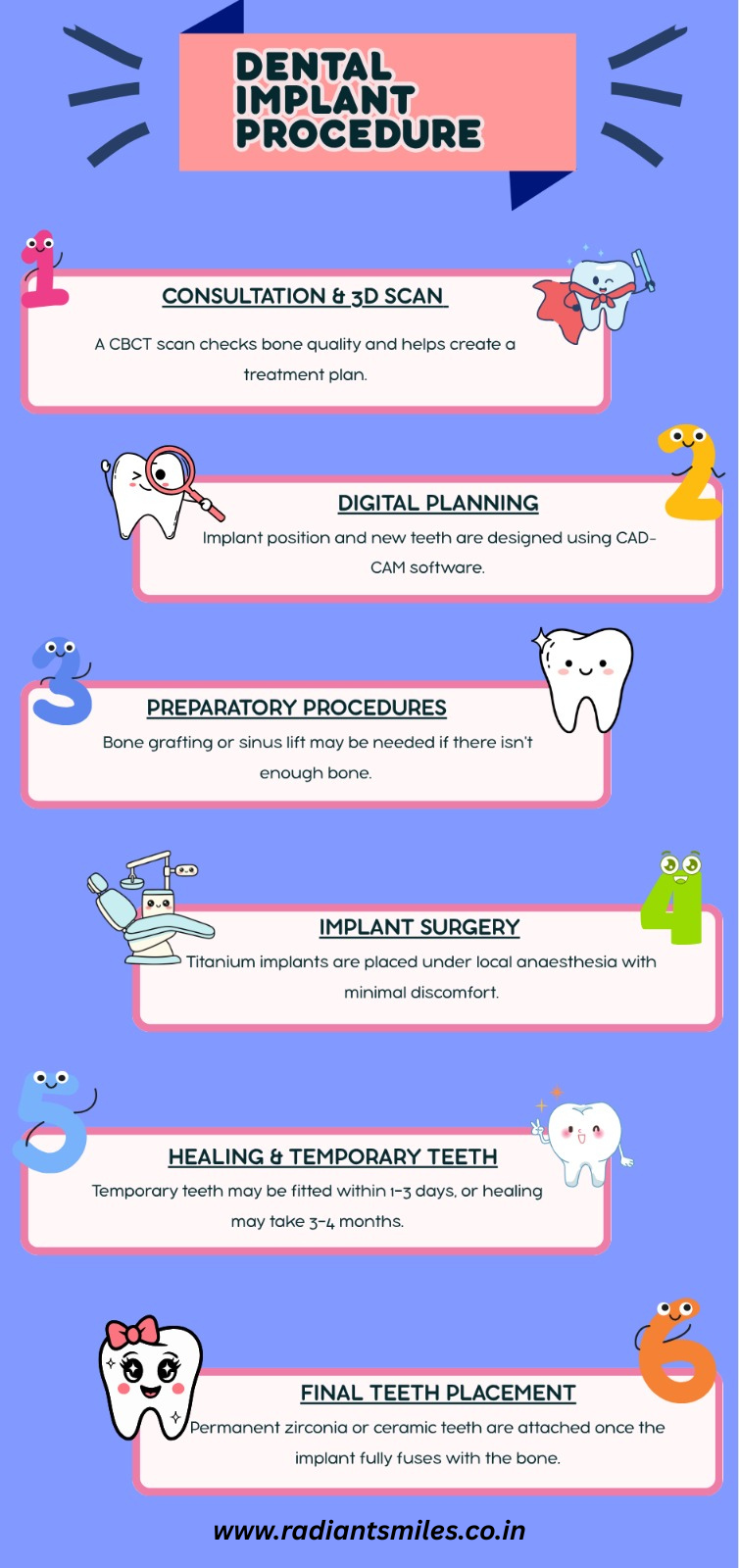
Step 1: Consultation and 3D CBCT scan
Everything begins with a thorough clinical assessment and a 3D cone beam CT scan. This scan maps your jawbone in three dimensions, bone height, width, density, proximity to the sinus cavities, and the location of the inferior alveolar nerve. At Radiant Smiles in Chembur, this scan is available on the same day as your first appointment, which means you leave with a clear picture of your situation and a preliminary treatment plan rather than being asked to return another day just to get started.
Step 2: Digital treatment planning
Using CAD-CAM software, the implant positions are planned virtually before any surgery takes place. This digital workflow eliminates most of the guesswork involved in conventional implant surgery. The prosthesis, your final set of teeth, is also designed at this stage. Patients can see the planned shape and shade of their new teeth and provide input before anything is placed.
Step 3: Preparatory procedures, if needed
If bone grafting or a sinus lift is required, this happens before implant placement and requires its own healing period. Not all patients need this, it depends entirely on what the CBCT scan reveals.
Step 4: Implant placement surgery
The surgery itself is performed under local anaesthesia. Conscious sedation is available for patients who feel anxious. Most patients report feeling pressure and movement during the procedure but not pain. The titanium posts are placed using a guided surgical template derived from the digital plan; this makes placement faster, more precise, and less invasive than conventional free-hand surgery.
Step 5: Immediate or delayed loading
If your bone density is sufficient, a temporary set of fixed teeth can be fitted within one to three days of surgery. This is called immediate loading, and it means you leave the clinic with a functional smile while the implants integrate with the bone beneath. For patients who require delayed loading, a healing phase of three to four months is necessary before the final prosthesis is attached.
Step 6: Final prosthesis fitting
Once osseointegration is confirmed, meaning the titanium posts have fused securely with the bone, your permanent zirconia or ceramic bridge is screwed into place. Bite adjustments are made and typically require one or two follow-up visits. At this point, the treatment is complete.
Total timeline from first consultation to final teeth: 3 to 6 months for most patients. With immediate loading and no bone grafting needed, some patients have their permanent-looking smile within a few days of surgery.
Full Mouth Dental Implants Cost in India and Mumbai: An Honest Breakdown
Treatment | Cost in Mumbai (₹) | Notes |
All-on-4 (single jaw) | ₹3,50,000 – ₹5,50,000 | Most patients; moderate bone loss acceptable |
All-on-6 (single jaw) | ₹4,50,000 – ₹7,00,000 | Better long-term stability; good bone required |
Full mouth (both jaws) | ₹7,00,000 – ₹12,00,000 | Zirconia bridge; varies by brand and grafting needs |
Implant-supported denture (per jaw) | ₹1,50,000 – ₹3,00,000 | Removable but snap-secured; more affordable entry point |
Bone grafting | ₹10,000 – ₹25,000 per site | Usually priced separately; not all patients need it |
Sinus lift | ₹20,000 – ₹40,000 per side | Upper jaw only; common after years of missing teeth |
Annual maintenance | ₹5,000 – ₹8,000 per year | Professional cleaning and routine check-ups |
Prices exclude extractions, sedation, and diagnostic scans unless specified. Always request a written, itemised estimate based on your CBCT scan before comparing quotes across clinics.
What drives the cost up or down
- Implant brand. Premium Swiss and European implant systems, brands like Straumann, Nobel Biocare, and Dentsply, are backed by decades of clinical data and carry higher price tags. Trusted Indian and Korean systems are more affordable without meaningfully compromising quality for most cases. Your dentist should explain which system is being used and why it suits your clinical situation.
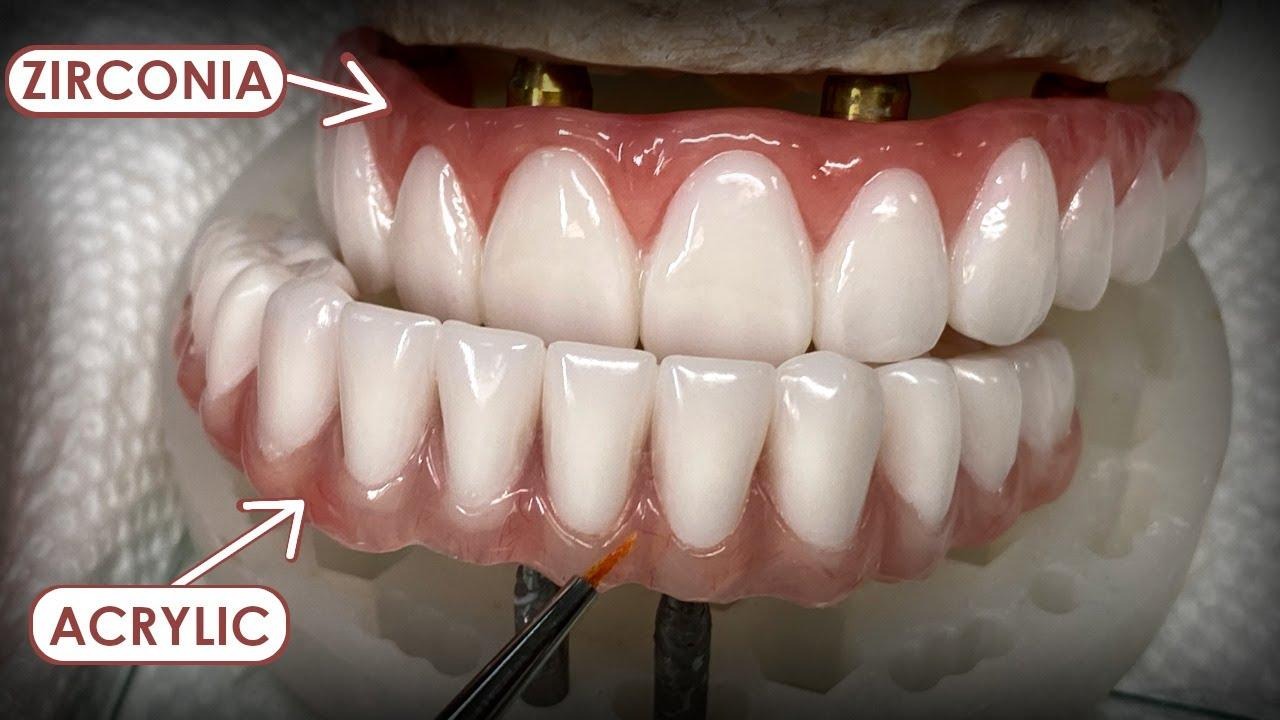
- Prosthetic material. Zirconia bridges are the gold standard, they are durable, aesthetically excellent, and highly biocompatible. Acrylic is more affordable and is often used for immediate-load temporary bridges. Porcelain-fused-to-metal (PFM) sits in between. Most patients who are investing in full mouth implants opt for zirconia for the final prosthesis.
- Bone grafting. If the jawbone has resorbed due to years of missing teeth, grafting is needed to create a stable foundation. Bone grafting in Mumbai costs approximately ₹10,000 to ₹25,000 per site. This is separate from the implant package in most clinics.
- Sinus lift. For the upper jaw specifically, the sinus cavity can encroach on the available bone height. A sinus lift procedure, which elevates the sinus membrane and adds bone graft material, costs approximately ₹20,000 to ₹40,000 per side. Not all upper jaw patients need this, but it is common when teeth have been missing for several years.
- Sedation. Conscious sedation is not always included in base quotes. If you prefer to be deeply relaxed or sedated during surgery, ask specifically whether this is included and what the additional cost is.
- Extractions. If you still have damaged teeth that need to be removed before implants are placed, extraction costs are typically quoted separately.
What is usually not included in packaged quotes
It is worth asking any clinic explicitly whether bone grafting, sinus lift, extractions, premium implant brand upgrades, and sedation are included or separate before you compare prices across providers. A quote of ₹3,50,000 per jaw that excludes grafting may end up costing more than a ₹4,50,000 all-inclusive quote. Transparency matters enormously for a treatment at this price point.
A patient from Ghatkopar came in having been quoted ₹2.8 lakh per jaw at one clinic and ₹5.5 lakh at another. On examination, the lower-cost quote was for a Korean value-tier system with acrylic teeth and excluded bone grafting that the patient's scan showed she clearly needed. The higher quote included a mid-tier European system, zirconia teeth, and the grafting. Once the comparison was on an equal footing, the difference was far smaller than it first appeared, and the materials being offered were genuinely different products.
Recovery, Aftercare, and How Long Full Mouth Implants Last
The recovery from full mouth implant surgery is far less dramatic than most patients anticipate.
In the first week, mild swelling and soreness are normal. These are managed with prescribed anti-inflammatories and pain medication. Patients are advised to eat soft foods for the first 10 to 14 days and to avoid smoking and strenuous physical activity for at least two weeks. Most patients return to desk work within two to three days.
The deeper healing, osseointegration, where the titanium integrates with your living bone, happens over three to six months and is not something you feel. It is a biological process, and the body does the work quietly.
Oral hygiene with implants
Caring for full mouth implants is similar to caring for natural teeth, with a few additions. Brushing twice daily with a soft-bristle brush is sufficient for the crown surfaces. For cleaning underneath the bridge, interdental brushes or a water flosser are more effective than standard floss. Twice-yearly professional cleaning at Radiant Smiles keeps the gum tissue around the implants healthy and allows early detection of any issues.
One important point: implant crowns cannot develop cavities. However, the gum tissue and bone around the implants are still living and can be affected by a condition called peri-implantitis, essentially gum disease around an implant, if oral hygiene is neglected. Healthy gums remain essential even when all your teeth are implants.
How long do full mouth implants actually last?
The titanium implant posts themselves can last 20 to 30 years with good care, and some patients never need them replaced at all. The prosthetic bridge typically remains functional and aesthetic for 10 to 15 years before an elective refresh might be desired. Clinical literature in the Journal of Oral Implantology, 2023 consistently reports success rates above 95% at the 10-year mark when patients maintain good oral hygiene and attend regular check-ups.
These are not temporary fixes. Full mouth implants, when placed correctly and maintained properly, are effectively a permanent solution.
Why Patients From Chembur, Ghatkopar, and Across Mumbai Choose Radiant Smiles
Patients travel to Radiant Smiles from Ghatkopar, Kurla, Govandi, Wadala, and Sion because of a specific combination of clinical technology, transparent pricing, and the kind of unhurried, detailed consultation that is unfortunately not the norm everywhere.
Every implant case at Radiant Smiles begins with a same-day 3D CBCT scan. This is not an upsell, it is essential for safe, precise implant planning. Using that scan, Dr. Srishti digitally plans the implant positions before any surgery takes place. The guided surgical templates that come out of this digital workflow make the actual procedure faster, less invasive, and more predictable.
The final prosthetics, zirconia bridges, are CAD-CAM milled for a precise fit and a natural appearance that is difficult to distinguish from healthy natural teeth.
Most importantly, every patient leaves the initial consultation with a written, itemised cost estimate. No hidden charges, no vague "starting from" figures. You know exactly what your treatment will cost before you commit.
Your Complete Smile Is More Achievable Than You Think
Living without your natural teeth, or struggling with dentures that don't feel like your own, is not something you have to accept as permanent. Full mouth dental implants have genuinely changed what's possible for patients across Mumbai, and the technology available at clinics like Radiant Smiles in Chembur today is more accessible, more precise, and more affordable than it was even five years ago.
Whether you've been missing teeth for years, are wearing dentures you've never been happy with, or have been told your remaining teeth need to go, a proper clinical assessment is the only way to know exactly what your options are and what they will cost.
Come in. Let's take a scan, look at what we're working with, and build a plan that's right for you, not a generic plan, but yours.
Book your consultation at Radiant Smiles Dental Clinic, Chembur. Call us, WhatsApp us, or walk in. Your complete smile starts with one appointment.
Radiant Smiles Dental Clinic: 438/A, 1st Floor Premalaya, V. N. Purav Marg,Opposite Telecom Factory, Deonar, Chembur, Mumbai, Maharashtra - 400088. , Chembur, Mumbai Phone: +91 89282 28842
Frequently Asked Questions About Full Mouth Dental Implants in Mumbai
1. How much do full mouth dental implants cost in India?
Full mouth dental implants in India typically cost between ₹3.5 lakh and ₹12 lakh, depending on the number of implants, restoration material, and whether procedures such as bone grafting are required. In Mumbai, most patients invest ₹7 lakh to ₹10 lakh for both jaws with a zirconia bridge. A CBCT-based consultation provides the most accurate personalised estimate.
2. How long does full mouth implant treatment take from start to finish?
For most patients, treatment takes three to six months from consultation to final teeth. If bone grafting is needed, healing may extend the timeline by an additional two to four months. Patients suitable for immediate loading may receive temporary fixed teeth within one to three days after implant surgery.
3. Are full mouth dental implants painful?
Implant surgery is performed under local anaesthesia, with conscious sedation available for anxious patients. During the procedure, patients typically feel pressure rather than pain. Recovery discomfort is usually mild and comparable to a tooth extraction, with most people returning to normal daily activities within two to three days.
4. Full mouth dental implants vs dentures. Which is the better long-term choice?
Dental implants are fixed, stable, and help preserve the jawbone by stimulating the bone during chewing. With proper care, they can last 20 years or more. Conventional dentures are removable, may shift during eating or speaking, and contribute to ongoing bone loss, often requiring replacement every five to eight years.
5. Can someone with significant jawbone loss still get full mouth dental implants in Mumbai?
Yes. Significant bone loss does not automatically rule out treatment. Options such as bone grafting, sinus lifts, and zygomatic implants allow many patients with reduced bone volume to receive fixed implant teeth. Dr. Srishti assesses each case individually using a 3D CBCT scan, and in most cases a viable path to fixed implant teeth can be found.
Dr. Vishwas Madan
MDS (Periodontics & Oral Implantology) — Periodontist & Implantologist
Dr. Vishwas Madan is a highly esteemed Periodontist and Implantologist, holding a Master's in Dental Surgery (MDS) in Periodontics and Oral Implantology. His training includes mentorship under world-renowned Dr. Ziv Simon in Beverly Hills, California, where he mastered cutting-edge implant techniques. With over a decade of experience, Dr. Madan specialises in advanced dental implants and full-mouth rehabilitation, having successfully treated over 15,000 patients using digital smile design and guided implantology.
His accolades include the Pierre Fauchard Academy Award nomination, Famdent Indian Dental Oscars, the XL Award for Practice Management, and the Leadership Award of the Year (2024). A double gold medallist and recipient of the IDA-Colgate & TATA Scholarships, Dr. Madan brings complex surgical expertise to Radiant Smiles, treating periodontally compromised patients with the highest level of care.
Book an Appointment with Dr. Vishwas Madan