


Dentures in Mumbai: Types, Cost & Are They Right for You?
Key takeaways
- Dentures range from ₹3,000 for a basic acrylic partial to ₹4,00,000+ for implant-supported full arch options, the right type depends on how many teeth are missing and bone condition.
- Complete dentures replace a full arch; partial dentures fill gaps when some natural teeth remain; implant-supported dentures clip onto implants for far greater stability.
- Immediate dentures can be fitted the same day teeth are removed; conventional dentures are made after 8–12 weeks of healing.
- Most patients adjust fully within 4–8 weeks, soft foods, even-sided chewing, and reading aloud help the process.
- Dentures don't prevent bone loss; implants do, for younger patients or those with active bone loss, implants or implant-supported dentures are worth comparing directly.
- A reline or replacement is normal after 5–8 years as gum and bone shape gradually changes.
Anyone researching dentures costs in Mumbai is usually dealing with one of two situations: either a few teeth are already missing and getting worse, or a dentist has just mentioned dentures as an option and the next question is naturally, how much, and is this really the best route. Both are fair starting points, and both deserve a straight answer.
Dentures in Mumbai typically range from around ₹3,000 for a basic acrylic partial to well over ₹4 lakh for implant supported full arch options. That's a wide gap, but it makes sense once the different types are understood. A survey of periodontal disease prevalence in Indian adults found periodontal disease present in roughly two thirds of adults aged 35 to 44, and in the vast majority of those aged 65 to 74, which goes some way toward explaining why tooth loss, and questions about dentures, come up far more often than people expect, and not just among older patients.
This guide walks through the main types of dentures available in Mumbai, what each one typically costs, who tends to be a good fit for which option, what the first few weeks are actually like, and how dentures compare to implants when both are on the table.
Types of Dentures Explained
Dentures aren't a single product. The right type depends mainly on how many teeth are missing, the condition of the gums and jawbone, and what feels manageable day to day.
1. Complete Dentures
These replace an entire arch, top or bottom, when no natural teeth remain. There are two ways they're done. Conventional complete dentures are made after the gums have fully healed following extractions, usually eight to twelve weeks. Immediate dentures are prepared in advance and fitted on the same day teeth are removed, so there's no gap without teeth, though they often need adjustment once healing is complete.
2. Partial Dentures
For patients who still have some healthy natural teeth, partial dentures fill the gaps and stop neighbouring teeth from drifting into the empty space over time. Cast partial dentures use a metal framework with clasps that hook onto existing teeth for a secure fit. Flexible partial dentures use a softer, gum coloured material without visible metal clasps, which many patients prefer for how natural they look, especially for front teeth.
3. Implant Supported and Snap In Dentures
For patients who want significantly more stability than a removable denture can offer, or who have lost enough bone that a regular denture keeps slipping, implant supported dentures attach to a small number of dental implants placed in the jaw. They cost more upfront but stay put far better, and they help slow the bone loss that tends to continue under regular dentures.
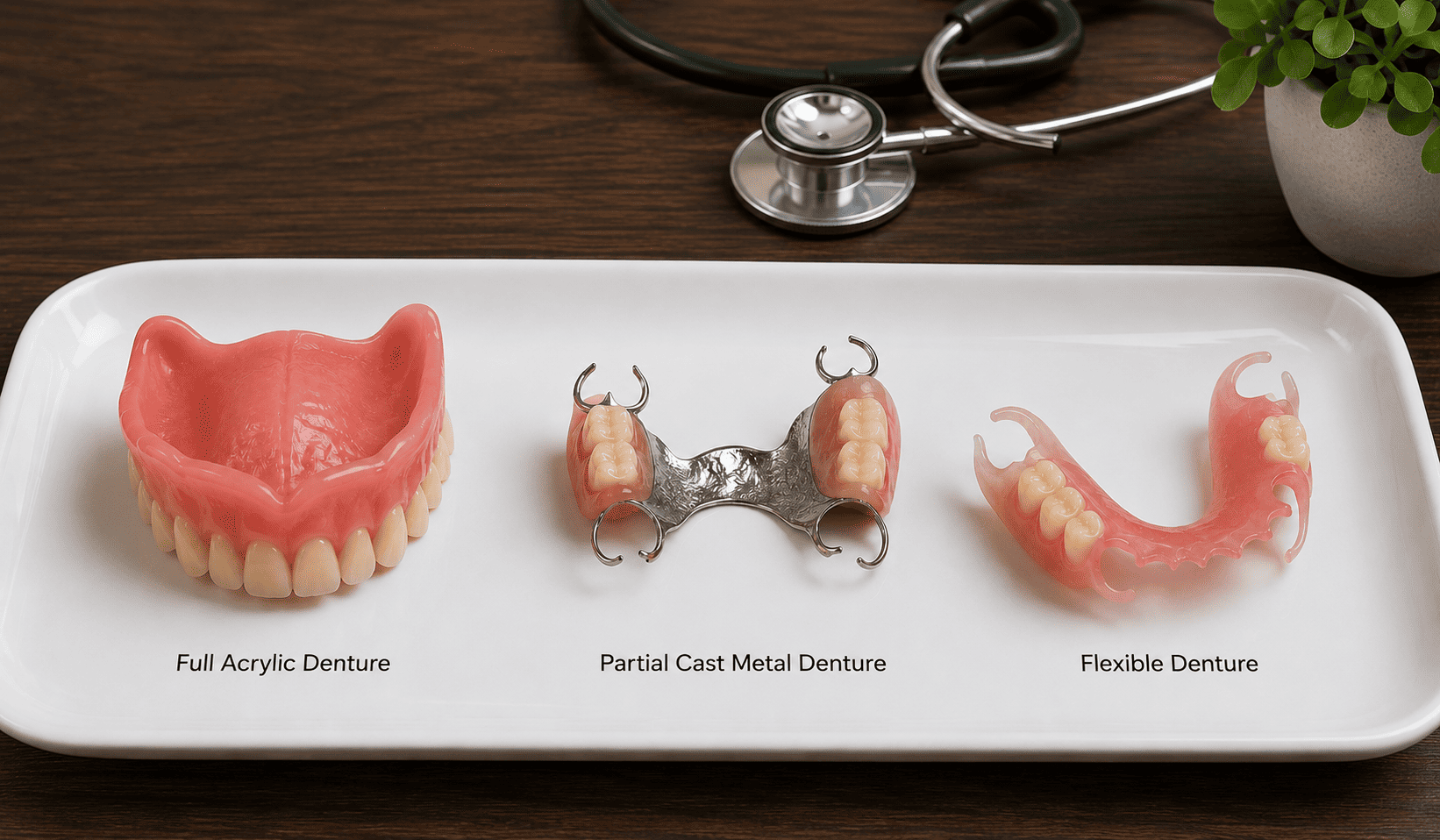
Denture Type | Best Suited For | Average Cost in Mumbai (₹) | Typical Lifespan |
Complete Acrylic Denture | Full arch with all teeth missing | ₹3,000 to ₹25,000 | 5 to 7 years |
Cast Partial Denture | Some natural teeth remain | ₹10,000 to ₹25,000 | 5 to 8 years |
Flexible Partial Denture | Visible front teeth where metal clasps are not desired | ₹8,000 to ₹55,000 | 5 to 7 years |
Implant Supported Denture | Patients seeking greater stability or with bone loss | ₹80,000 to ₹4,00,000+ | 10+ years |
Who Is a Good Candidate for Dentures?
There's a common assumption that dentures are only for people in their seventies. In practice, the need can show up much earlier, sometimes in someone's forties or even thirties, depending on how oral health has been managed over the years.
A few signs are worth paying attention to. Teeth that feel loose or seem to be shifting position, gaps that are visibly widening, more than one missing tooth in the same area, and gums that bleed regularly when brushing are all reasons to get checked sooner rather than later. None of these mean dentures are automatically the answer, but they're signals that something needs attention before the situation gets harder, and more expensive, to manage.
Dentures vs Implants: An Honest Comparison
Both restore the ability to chew and smile with confidence, but they work very differently. Dentures sit on or are clipped onto the gums and existing teeth, are non surgical, and cost less upfront. Implants are placed directly into the jawbone, involve a healing period of a few months, cost more initially, but tend to last far longer and help preserve the bone underneath, which dentures alone don't do.
One patient who came in recently had assumed dentures were the only realistic option after losing three back teeth over a couple of years. After a closer look, it turned out two implants placed in the right spots would support a small fixed bridge, avoiding a removable appliance altogether, at a cost that, while higher upfront, worked out more practical for someone in their early fifties who didn't want to deal with removable teeth for the next few decades. Not every case ends up this way, sometimes a partial denture really is the right call, but it's worth having both options properly explained before deciding.
For anyone weighing this decision more closely, the dental implants vs dentures comparison breaks down the pros, cons, and costs of each side by side. And for those considering replacing an entire arch with implants rather than a removable denture, the dental implant cost guide covers full mouth dental implants cost in India in more detail, including what drives pricing for larger cases.
Dentures Cost in Mumbai by Type
The table above gives the headline numbers, but a few things shift the final price within each range.
Material choice matters most for partials, flexible dentures cost more than cast metal frameworks but tend to feel more comfortable and look more natural. The number of arches involved obviously affects cost too, a full set, upper and lower, costs more than a single arch.
The condition of the gums and jawbone plays a bigger role than most people expect. If teeth need to be extracted first, or if the ridge needs reshaping before a denture will sit properly, that adds to both the cost and the timeline. The number of fittings required, and whether digital scanning and fabrication is used instead of traditional impressions, can also shift the price somewhat, though usually not dramatically.
For patients in Chembur and nearby areas like Ghatkopar, Govandi, Wadala, Sion, and Kurla, pricing tends to sit toward the lower to middle end of these Mumbai wide ranges, though the only way to know for sure is a proper examination and written quote.
All prices are starting ranges and exclude extractions or additional procedures unless specified. Always ask for a written, itemised treatment plan before committing to any work.
A Note on Implant Supported Dentures
For patients who want more stability than a removable denture but aren't ready for, or don't need, a full set of individual implants, implant supported or snap-in dentures often hit a useful middle ground. A small number of implants, sometimes as few as two for a lower arch, can support a denture that clips firmly into place, dramatically reducing the slipping and discomfort that often comes with conventional dentures.
Getting Used to Dentures: What to Expect
Most patients adjust to new dentures within four to eight weeks. The first few days can feel strange, and that's completely normal, not a sign that something has gone wrong.
1. Eating
Starting with soft foods cut into small pieces makes the first week or two much easier. Chewing evenly on both sides of the mouth helps the denture sit more securely than chewing on just one side. Gradually returning to a normal diet over a few weeks is the typical pattern, and most patients get there without much trouble.
2. Speaking
A slight change in speech, sometimes a mild lisp or a feeling that the tongue has less room, is common in the first one to two weeks. Reading aloud for a few minutes a day helps the mouth adjust faster, and this almost always resolves on its own.
3. When to Call the Clinic
A short adjustment period is expected, but a few things shouldn't be ignored. Sore spots that don't ease up after several days, a denture that feels loose or rocks while eating, or any irritation that seems to be getting worse rather than better are all reasons to book a follow up. A quick adjustment usually sorts these out, and waiting too long can turn a minor issue into a sore that takes longer to heal.
Caring for Dentures: Cleaning, Lifespan, and When to Replace
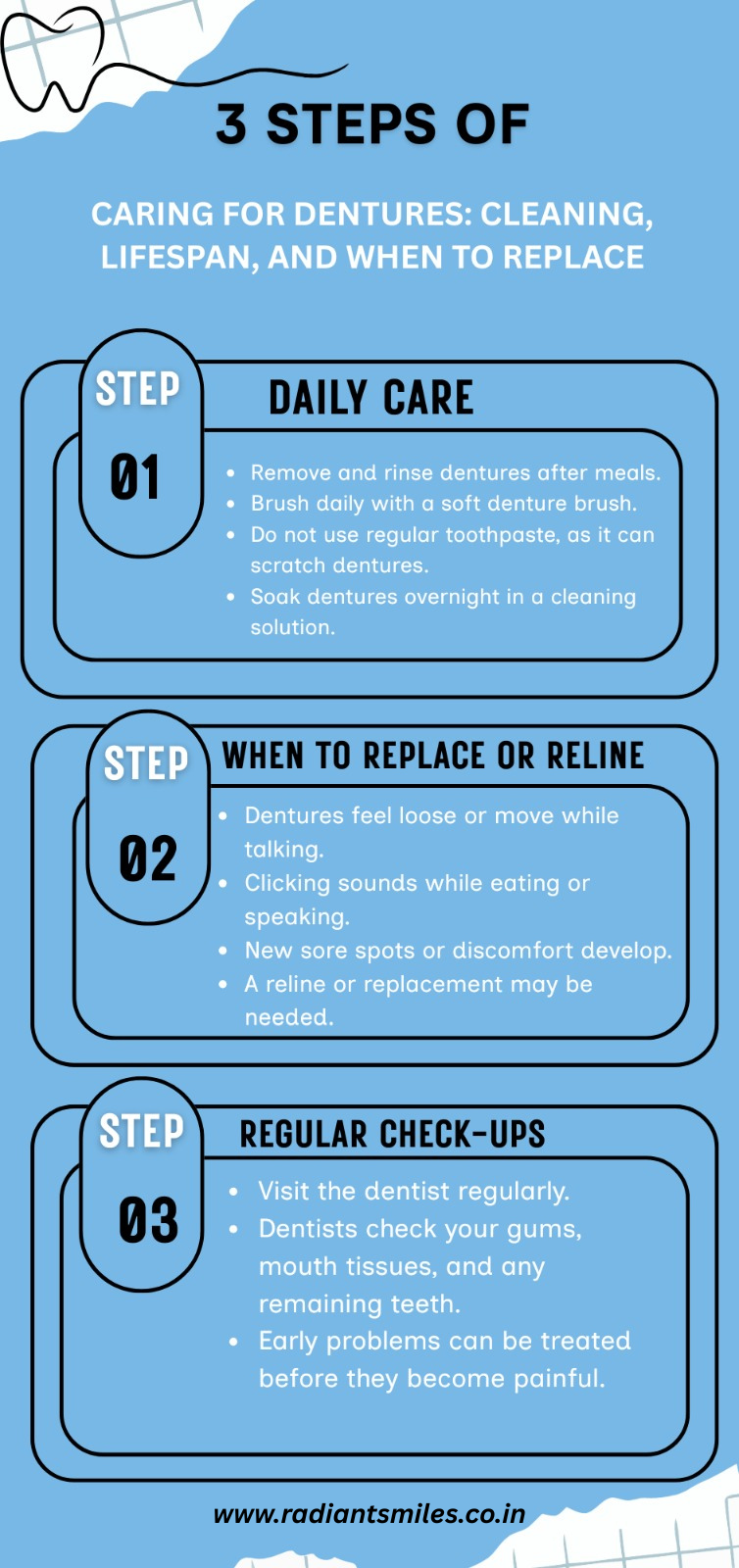
With proper daily care, dentures typically last five to ten years. That said, they don't stay exactly the same the whole time, and knowing what to watch for makes a real difference.
Daily Care
Dentures should be removed and rinsed after meals to clear away food particles, and brushed daily with a soft denture brush, ordinary toothpaste is too abrasive and can scratch the surface over time. Soaking overnight in a denture cleaning solution keeps them fresh and helps maintain their shape.
Signs It's Time for a Reline or Replacement
Gums and jawbone shape change gradually over years, even in patients who never had natural teeth removed recently. A denture that once fit snugly can start to feel loose, click while talking or eating, or cause sore spots that weren't there before. These are usually signs that a reline, where the fitting surface is adjusted to match the current shape of the gums, is needed, or in some cases, that a new denture altogether is the better option.
Why Regular Check-ups Still Matter
Even with a full set of dentures, regular dental visits remain important. Gum tissue, the roof of the mouth, and any remaining natural teeth all need checking, and a dentist can spot fit issues, early sore spots, or other oral health changes well before they become uncomfortable.
Why Chembur Patients Choose Radiant Smiles for Denture Care
Patients across Chembur and nearby areas regularly ask whether good quality denture work, and a fair comparison with implants, is available locally without travelling across the city. At Radiant Smiles, it is. The clinic handles the full range, complete, partial, flexible, and implant supported dentures, alongside the implant procedures themselves, so patients can have an honest conversation about both options in one place.
Every recommendation comes with a written, itemised cost breakdown before any work begins, covering the type of denture, materials, number of visits, and any preparatory work needed. A lot of patients arrive assuming dentures will look or feel a certain way based on what they've heard from others, and one of the more common parts of a first consultation is simply walking through what modern dentures actually look and feel like compared to those assumptions.
Radiant Smiles Dental Clinic 438/A, 1st Floor, Premalaya, V. N. Purav Marg, Opposite Telecom Factory, Deonar, Chembur, Mumbai, Maharashtra 400088 Phone / WhatsApp: +91 89282 28842
Anyone weighing dentures against implants, or just wanting a clear cost estimate based on their specific case, can call or message on WhatsApp to book a consultation.
Final Thoughts
Dentures remain one of the most reliable, affordable ways to restore a smile and the ability to eat and speak comfortably, and for many patients, they're exactly the right call. For others, especially where bone loss is a concern or long term stability matters more than upfront cost, implants or implant supported dentures might be worth a closer look. The only way to know which fits a particular situation is a proper examination, not a generic price list.
For anyone in Chembur or the surrounding areas trying to figure out the right option, booking a free consultation at Radiant Smiles is a simple first step, no pressure, just a clear picture of what's needed and what it will cost.
Frequently Asked Questions
1. How much do dentures cost in Mumbai?
Dentures cost in Mumbai ranges from around ₹3,000 for a basic acrylic partial to ₹25,000 for a complete acrylic denture, and from ₹80,000 to over ₹4,00,000 for implant supported options. The exact cost depends on the type chosen, the number of arches involved, and the condition of the gums and jawbone.
2. How long do dentures last?
With proper daily care, dentures typically last five to ten years. Over time, the gums and jawbone change shape, which can affect how well a denture fits, so a reline or eventual replacement is normal rather than a sign anything went wrong.
3. Are implant supported dentures worth it?
For patients dealing with looseness or bone loss, implant supported dentures often make a noticeable difference in comfort and confidence, and they tend to last significantly longer than conventional dentures. The higher upfront cost is the main trade off, and the implants vs dentures comparison walks through this in more detail, including how it compares to full mouth dental implants cost in India for those considering a non removable option entirely.
4. Do dentures change how I eat and speak?
There's an adjustment period, usually four to eight weeks, where minor changes in speech and chewing are completely normal. Starting with soft foods and practicing speech by reading aloud helps speed up the adjustment, and most patients adapt fully without ongoing issues.
5. Can I get dentures done in one day?
Immediate dentures can be fitted on the same day teeth are removed, so there's no gap without teeth during healing. Conventional dentures, on the other hand, are made after the gums have fully healed, which usually takes eight to twelve weeks. Both approaches are valid, and which one makes sense depends on the individual case.
Dr. Vishwas Madan
MDS (Periodontics & Oral Implantology) — Periodontist & Implantologist
Dr. Vishwas Madan is a highly esteemed Periodontist and Implantologist, holding a Master's in Dental Surgery (MDS) in Periodontics and Oral Implantology. His training includes mentorship under world-renowned Dr. Ziv Simon in Beverly Hills, California, where he mastered cutting-edge implant techniques. With over a decade of experience, Dr. Madan specialises in advanced dental implants and full-mouth rehabilitation, having successfully treated over 15,000 patients using digital smile design and guided implantology.
His accolades include the Pierre Fauchard Academy Award nomination, Famdent Indian Dental Oscars, the XL Award for Practice Management, and the Leadership Award of the Year (2024). A double gold medallist and recipient of the IDA-Colgate & TATA Scholarships, Dr. Madan brings complex surgical expertise to Radiant Smiles, treating periodontally compromised patients with the highest level of care.
Book an Appointment with Dr. Vishwas Madan